In this article, I'll look at some popular knives and discuss what each type of knife is designed for (and some unconventional uses for them).
Related Articles
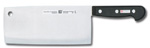 The chef's knife is the one knife that is consistently rated as the single most essential in the kitchen. However, if I could only pick one knife to have in the kitchen, it would be a Chinese or Asian cleaver. This knife's sharp edge is thin enough and sharp enough to easily cut and mince food and at the same time strong enough to handle light cleaving jobs. The side of the blade can be used to smash garlic and ginger and the top edge san be used (with care) as a meat tenderizer. The broad blade is often used to move food from the cutting board to the stove. However, due to the overall shape and size of a Chinese Cleaver, there is not as much precision as a chef's knife. Since I have a full compliment of knives, my Chinese cleaver sits on the sidelines waiting for the day when I can only have one knife to use.
Chef's Knife
 The most versatile knife in the western kitchen is the chef's knife. It is used for cutting, slicing, chopping, and mincing. The curved blade allows rocking back and forth for fine chopping and mincing. Chef's knives come in blade lengths from 6 to 12 inches. The longer the knife, the more you can cut, but the more difficult it is to control. If you've got small hands (like I do), you may want to stick with the 6 to 8 in. variety. Tina uses a 6 in. while I find the 8 in. allows me to grip the knife just forward of the bolster with my forefinger and thumb without discomfort (the 6 in. is slimmer so the back of the knife digs into the side of my knuckle). If you've got one of these and a board scraper, you won't need or want to use an Asian cleaver.
Santoku
 This is the Japanese equivalent of a chef's knife and has been gaining in popularity in Western kitchens. It has a broad blade and a tip that is lower than a chef's tip. Typically made thinner than a chef's knife, it does not have as much structural strength or weight, but is great at all chef's knife functions except for cutting through bone. Many brands now carry santokus, but a few have made poor design decisions (edge is almost flat, tip too low, knife too thick, etc.). The Shun Classic Santoku shown here is probably the best santoku on the market right now. Unfortunately, for left handers, it's a right handed knife (the unique D crosssection handle fits right handers).
Paring Knife
 The paring knife is great for working a blade in a small space. Paring apples, cutting fruits, butterflying shrimp, and seeding a jalapeno are just some of the tasks the paring knife is well suited for. The paring knife has a thin blade that makes it easy to manuever while cutting. The sharp tip is also useful for removing potato eyes and other such tasks. In general, a paring knife is simply a miniature chef's knife - designed with the same curves and angles but smaller. This makes switching between the chef's knife and the paring knife a natural action.
Carving Knife (Slicing Knife)
 A carving knife's special purpose is to carve poultry, roasts, and hams after they have been cooked.
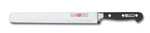 Carvers typically have points to reach into tight places, but roast beef carvers have blunt ends. Some have hollow recesses along their blades and are referred to as granton or hollow edged or scallops. These air pockets allow for thinner slicing because they prevent meat slices from adhering to the blade. Why use a slicer instead of a chef's knife? Thickness. A carving knife is much thinner, enabling the knife to slice through finely while a thicker knife will wedge and tear the cooked meat once it cuts in too deep.
Bread Knife
 A bread knife's job in life is to cut, you guessed it, bread. Many breads have a hard crust which keeps a slicer or chef's knife from digging in and gripping the bread when you start to cut. You can use the tip of the chef's knife to punch a hole where you want to cut and then slice, but what about soft breads? With soft breads, the chef's knife doesn't clip around on the crust, but while you cut into the bread, you compress it instead of slicing clean through. A bread knife solves both problems by providing large serrations that grip the crust and can saw through soft breads without squishing them. This knife is also useful for cutting dense cakes (yellow cakes, pound cakes), but use a fine serrated knife for light cakes (angel food cake).
Utility Knife
 This knife is the in-between knife. If you've got a 4 in. paring and a 10 in. chef's, you might want a 6 in. utility knife for all those jobs in between. Sometimes it's also called a tomato knife (usually when it has medium serrations) or a sandwich knife. Since Tina uses a 6 in. chef's knife, I use that instead.
Boning Knife (Fillet Knife)
 This thin knife allows you to remove membranes from meat and meat from bones easily. Usually, it is made thin enough for the blade to be a little flexible. Typically, this will be the sharpest knife you own because it will also be the thinnest knife. Use this to cut anything soft that needs fine precision work, but don't cut semi-frozen meat with this blade (use a chef's knife for that). The Victorinox or RH Forschner brand boning knife with Fibrox handle is probably the best boning knife available and is 1/5 the cost of most high end knives. This model goes for $10 and the handle doesn't get slippery when coated with juice and membrane from the poultry you're working on.
Meat Cleaver
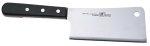 This knife is used to hack pieces of meat with bone apart. Usually imprecise due to the amount of force you need to use, the meat cleaver sections meat pretty well. I suggest using a seperate cutting board because you'll probably cut into the board a bit. In western cooking, there will be very little need for this knife because most of the time we trim the meat off the bones. When quartering a chicken, a boning knife is used and we avoid cutting through bone (unless we're doing it Asian style where having slivers of bone is part of the look and feel). Most of the time the butcher handles the bone cutting for us with their rotary and band saws (which produce much cleaner cuts than a meat cleaver).
Steak Knife (Dining Knife)
 This is the knife your guests will use to tear cooked meat into bit sized chunks. It's usually best to have large pieces of cooked meat served whole to preserve the juices and have your guests cut them. A steak knife does not cut meat as much as it tears very finely.
What to look for in knives? Here's a short list of stuff people usually tell you what to look for:
- Full tang - The tang is the part of the knife blade that is embedded in the handle. It is not necessary to buy a knife where the tang goes all the way to the back (full tang). Make sure it has at least 3/4 tang though, any less and the balance might feel weird (you don't feel like you're holding the knife; it feels like your holding a handle that's holding the knife...), constant use of over the years could result in loosening of the blade from the handle, or it might just fall out if you use too much force.
- Forged - Stainless steel knifes are generally forged or stamped. Forged knives are typically more durable and are usually thicker (more structural support). I like my chef's knives to be forged and my bread knife to be stamped (because stamped is thin and cheap). You can get all forged, but it will cost more (a nice forged slicer will also be thin, but will be pricey compared to a stamped version). The forged ones are reputed to hold an edge longer as well. I'll take this opportunity to point out that some companies like J.A. Henckels have started to do a composite stamp/forge which they claim makes their knives better than plain forged. Basic metallurgy tells us that it's probably not true, but personally I like the feel of their knives and haven't had any complaints about durability or cutting ability.
- Diamond edges - Some knives advertise "never need sharpening" due to a diamond coated edge (or something like that). I would recommend against these knives because they do eventually get dull and you can't sharpen them. Same with ceramic knives - you have to send them back to the factory for sharpening.
- Serrated edges - Some knives are serrated. That's fine. Some chef's knives are serrated. That's not fine. Serrated knives cut by tearing. This is fine for some foods (breads and cakes) but not for food preparation. A sharp smooth edge works better than a serrated edge - just remember to use a slicing action instead of pushing down through the ingredient (chopping). Remember, we're cutting, not sawing.
So what's the final verdict? Here we go:
Buying 1 knife only
- Either Chinese cleaver or Santoku
Buying 2 knives
- Chef's knife (or Santoku; from now on, I'll just say Chef's knife but I mean either)
- Paring knife
Buying 3 knives
- Chef's knife
- Paring knife
- Carving knife (if you roast) OR bread knife (if you eat a lot of bread)
Buying 4 knives
- Chef's knife
- Paring knife
- Boning knife (unless you don't prepare beef, pork, poultry, or fish)
- Carving knife (if you roast) OR bread knife (if you eat a lot of bread)
How about buying a knife set? It depends. Most of the time knife sets come with one or two good knives and the rest are not so good (that's why they put it in a set). Often you're better off buying the knives individually and as you need them instead of all at one time.
Related Articles

Anyone want to send me a set to test? I haven't had any direct experience with Ronco knives. I've found that
in general Ronco products work (tried their rotisserie, etc.) but aren't the best solution for the job.
For knives, especially, I would recommend not to skimp. It is better to have a couple excellent knives
than to have six okay ones. First make sure the knives fit your hand - do you have big or small hands? Do you always hold it buy the handle or do you choke up the blade a bit?
I wouldn't worry about getting a set that looks symmetrical and identical, my set contains a variety of different handles and brands depending on the application.
Some recommendations:
Mundial is a good lower cost professional knife set. If you don't have the money for the higher quality knives, Mundial knives are a great option for durability and usability.
Forschner (Victorinox) is even lower in cost. The knives are stamped but serve extremely well under abuse and are low cost enough to replace in the future. This is a favorite in many food service industries.
Shun These are probably my favorite knives so far. The quality, sharpness, and look of the knives are amazing. Great if you are right handed - not so great for lefties. Their sets are pretty good, but you'll have to consider if you need every knife in the set or you are better off piecing your personal set together over time.
J.A. Henckels is the high end line of Heckels knives available. There is also a Henckels International line which for the cost conscious. Keep in mind the Henckels International line is not the same quality as the J.A. Henckels knives. (Note: These knifes are composed of multiple types of metals and not traditional forged. Some believe it weakens the knife, some say it makes the knives better. I can't tell the difference, but I will say that the Four Star handles fit my hand better than any other knife line so that is why my main knife is a Four Star 8-Inch Chef's Knife.
Wusthof is a line very close in quality to Henckels. Some say they are better, some say they are worse. In my opinion, I would rate both the same quality level. These knives are traditional forged from a single piece of steel (which is what sets them apart from Henckels). Take your pick (or buy Shun).
I take my knives out to be sharpened by a professional. My knives don't need sharpening often enough that I get in enough practice to be happy with my results. I used to sharpen my Buck, Swiss Army, and Leatherman knives fairly often, but since I've become less outdoorsy, I've fallen out of the habit. Electric sharpeners will grind away steel indiscriminantly - sure it will be sharp, but not as sharp as if you got a pro to do it for you. Anyway home sharpeners don't come with the eyes or experience of a professional sharpener.
Honing is a different matter. Hone before every use or once a week if you don't use your knives very often. (If once a week is too often for you, then once a month or whenever you can get yourself to hone the knife.) Honing is a difficult subject to describe so I'll have to post a separate article on this topic with pictures.
Basically, you make a motion along the steel as if you are cutting a shaving off of it while moving the knife from bolster to tip. Repeat several times and do the same for the other side of the knife. Then start over with the first side and repeat less and less until you do one stroke on each side.
The Spyderco set is nice, in that each stone is triangular, so you can do serrated knives easily, as well as shears/scissors, pocket knives, etc. where you have a tighter space to work with.
The prices really vary. Best I've found is Walmart.
PLEASE people, PLEASE do not under any circumstances scrape things off the cutting board with your knife blade. Use the back of the knife. Depending on how often you do something like this you can get another couple of months between sharpenings if you just take care of the blade.
It's the small things that pit and destroy your knife. The edge is why you have the knife, do everything you can to protect it.
I recommend investing a couple of dollars in a metal board scraper (or bench scraper or bash & chomp or dough cutter or dough blade). Excellent for scraping stuff up off the board and it doesn't have a sharp edge threatening to hurt you as you carry food to the pot or bowl. Also bashes garlic, cuts pastry dough and a acts as a ruler.
They really are the best cutlery in the world.
Chicago Cutlery: Made in China, if you have any look and see
Henkel's: Only second best
Cutco produts are hand made in the United States. This means they may cost a little more, but you get what you pay for. They're made of surgical grade steel. They have full tang handles. The Double D edge means they'l never need sharpening.
The handles are not only ergonomic (so well designed to fit the hand that even handicapped people who can't normally use a knife can use these), but they are beautiful as well. The Cutco Homemaker set is on display in the National Museum of Modern Art in New York City.
On top of that they have the forever garuntee. Not "lifetime" or "lifetime of the owner." Forever; as long as the company still exists. Even if the knives are damaged from missuse (ie; opening paint cans) the company will replace the knife at no cost. One woman's house burned down with her homemaker set inside, and the company replaced the entire set.
I'm not just saying this to sell them. I used to, but I absolutely hated the job. But, I still love the knives and regularly use mine. I was well educated during my training and these really are the best knives in the world.
Personally, I use a two sided ceramic sharpener (Spyderco's Double Stuff) and a steel hone. But, I find sharpening relaxing, and doing it that way takes at least a half hour.
For the best quick edge, on straight or serrated, Spyderco makes a set of oval crock sticks - Model Galley V. They are 12"long, enough to sharpen just about any knife, and easy: just pull down, one stroke on one side, one oh the other. About a dozen strokes and it's wicked sharp.
If you can find a set, well worth the purchase.
-Rich
As far as sharpening goes, I prefer to get mine done professionally. They know what they're doing, and if you sharpen too often you won't have much of a knife left after a while. Hone your knives every day you use them.
http://www.chefsresource.com/globknivcomv.html
As a side note, any woodworkers out there would be wise to check out their selection of woodworking tools as well. Japanese chisels are oh so sharp.
http://www.ameritech.net/users/knives/Juranitch1977Feb.htm
Regarding bread knives, I find that they're also great for sawing at some frozen items, such as the block of mirepoix that I keep in the freezer.
Hattori HD Series:
www.japanesechefsknife.com
Shun:
premiumknives.com
for the best of the best, read these high quality kitchen knife forums:
ubbthreads cutlery
knifeforums.com
You know, guys, I was thinking of making some rope and leather soup, garnished with penny bits - maybe I should buy some of these knives...
Seriously though - Cutco is more marketing than substance. I don't know a single serious cook (and I know many professional chefs) who use these things, and don't know any serious knife people who don't throw up a little when the subject comes up.
Don't drink the Kool Aid.
Shun and Global are great knives from Japan that keep a good edge and sharpen up well. Henkels and Wusthof are good, but expensive and heavy. Go into a professional kitchen and you'll see lots of Forschner and Victorinox knives - they're real workhorses.
In short - learn how to use a knive correctly (there are lots of online resources), learn how to sharpen it (again - online) or find a professional sharpener, and buy quality stuff.
KnifeForums.com has lots of information about knives and sharpening - kitchen knives included. EGullet is a fantastic cooking resource with lots of information on knives, keeping them sharp and how to use them for common tasks in the kitchen.
One addition to the knives mentioned would be an offset handle serrated knife - they're great for stuff like pineapple or tomatoes.
Have fun!
ths thing can take a finger or two off in a secound so be careful.
as for sharpinging.. i use a steel and have it sharpened by a pro every 6 mounths. do not skip this step if you want the knife to last. i would also recomend going to a good butcher and have him show you how to use a steel corectly! my parents owned a butcher shop whan i was a child and thats where i learned
Anthony Bourdain, in Kitchen Confidential, swears by Global. From what I can tell from friends who have them, they're excellent. However, my problem is that the all-metal handle can become slippery and cause problems. Some people love their modern look. I hate it.
Bobby Flay, on his webpage, recommends either Kershaw or Viking. He uses the former, but says that their extreme ("scary") sharpness can be extremely dangerous for home cooks who have never, say read Pepin's Complete Techniques or the CIA's knife skills book.
Alton Brown recommends Kershaw, but his opinion can't really be trusted since he's paid to be their spokesman.
Cutco...?
Chicago Cutlery...?
For the home consumer there are three brands to know.
Global.
Wusthof.
Henckels.
Its really that simple.
I personnaly prefer the Global knives...light, winners of many a competition on "sharpness" and look so much cooler than the competition.
But not to cast the other two in a bad light. They're both brands with a strong history and who offer high level knives.
Global.
Wusthof.
Henckels."
Are you kidding me? First of all you forgot Shun in your list of decent, yet inferior knives. The VG10 Steel in the Shun and Global is superior to the German Wusthof & Henckles, but even still Shun and Global are at the bottom of the food chain as far as quality knives go. We can do better, I'll show you:
These are SOME of the brands that the Home Consumer should know:
Tojiro
Hattori
Nenox
Masamoto
Suisin
Dojo
Misono
Ryusen
Masahiro
Glestain
MAC
Hiromoto
Ittosai Kotetsu
Watanabe
Takeda
Carter
Where to research:
http://www.knifeforums.com/ubbthreads/postlist.php?Cat=&Board=Kitchen
http://216.91.137.210/ubbthreads/postlist.php/Cat/0/Board/cutlery/
(If you are wondering about Cutco, well it is a standing JOKE on these forums. Take a look)
Where to buy:
http://www.japanesechefsknife.com/
http://www.korin.com/
http://www.epicureanedge.com/
http://watanabeblade.com/english/
http://shop.niimi.okayama.jp/kajiya/en/top_e.html
Take a look:
Knife Forums Thread
Seems like everyone thinks they are a joke. Especially if they are really a step down from Globals and Wusthofs which are still only mediocre knives.
One TV show that actually uses good knives is Iron Chef. The Nenox S series prominently show up there. Check em out:
http://www.japanesechefsknife.com/NenoxS1.html
Benchmade Kitchen Knives
If you have any questions I would ask them there and people who know knives will be glad to help you research.
Quote from thread linked above:
"They are nice knives that are very expensive. They are visual art and carry the benchmade name which seems to fit their business goal. People who know nothing about kitchen knives can buy these and get a good using kitchen knife that has huge visual appeal with the benchmade name.
The same quality and performance can be found elsewhere cheaper."
I suggest that you go to decent knife store and test them out personally. As some one already said on here. Make sure you don't have sharp edges on the back (i.e. Global) that are uncomfortable on your palm and fingers.
Get a decent grip? Remember how those oils and fish moistures make things slippery. I like wooden handles just for this reason.
My personal favorites, I have tested quite a few over the years so these are the once I still use:
Victorinox - Built like an ol' 240 Volvo. Basic, good metal and sturdy. Yes it's the same company that makes the legendary Swiss Army knife. =)
Mac - My pick for situations that need sharpness, precision and agility. Pricey but worth every penny. Hand crafted parts, top notch finish. Just the best I ever handled this far.
Neither brand has style points worth a empty calm shell. Then again I am way to practical to think about that for my tools, for me it's the end result that counts. =)
Globals are excellent knives but not the absolute best. Please do not be so ignorant. Just a few stainless knives that I find superior:
http://www.japanesechefsknife.com/HDSeries.html
http://www.japanesechefsknife.com/KDSeries.html
http://www.japanesechefsknife.com/NenoxS1.html
http://www.japanesechefsknife.com/UX10Series.html
http://www.japanesechefsknife.com/PowderedHighSpeedToolSteelSeries.html
the list goes on...
knifemerchant is a great website but as you can see I prefer japanesechefsknife.com for their selection, service and prices!
The absolute best knife that I own:
[330mm Blue Steel Yanagiba handmade by Shinichi Watanabe]
also, the sharp corner of the chinese cleaver nearest to you is very useful and powerful. It can do things like splitting up a coconut. chinese cleave rulez
also, the sharp corner of the chinese cleaver nearest to you is very useful and powerful. It can do things like splitting up a coconut. chinese cleave rulez
What kind of chinese cleaver do you use?
A lot of chinese cleavers are actually thinner than your average chef's knife. When you start talking about splitting cocunuts I am beginning to think that you are using one that is meant for bones, rather than the light vegetable and meat cleaver that is the replacement for a chef's knife.
Take a look at some real Chinese Cleavers:
http://www.japanesechefsknife.com/ChineseCleaver.html
I'm currently eyeing the Suien Chinese Cleaver for $128...sweet knife and good price....
I googled these and noticed a full bolster on some lines...no thanks...can't sharpen as well at the heel and shortens the life of the blade...I'd avoid cheap knives like these at all costs...
How do you sharpen them? By what criteria do you deem them to hold an edge and take one easily?
I have been pondering a better knife for a while. I've used a Henckels 4-star chef's knife for many many years and been quite happy with it. I manged to snap 10mm off the tip of it a few weeks ago (misusing it of course on only partially thawed beef, sigh...my bad) and I'm thinking of upgrading. I like the Misono (for a chef's knife) the best so far. Anyone have one? Used one? Know anything about them? (440 series since I can get sharper with high-carbon but my occasional laziness will result in rust). Hattori looks out of control, especially pricewise, and their damascus-clad blade looks like more of a marketing gimmick than really useful.
I haven't found any sources for the 'blue paper steel' knives and some good performers for very good slicers (both for sushi and other general slicing tasks, such as Peking Duck or similar).
I picked up a chinese cleaver of no name in chinatown right after I damaged my Henckels, and I'm very happy with it so far. Only $25, the store owner claimed that 'all the restaurant chefs here in chinatown use this one, it is the best you can get' (at least that's what my friend who was translating the mandarin for me said). I dunno, I haven't had it long enough to really judge the edge staying power, but it is a very surprisingly good knife for such an incredibly cheap price.
BTW, I am in no particular hurry to get the chef's knife since the cleaver definitely rules. It is as good or better than the 10" chef's knife for every task except those that require the full length, and have the smashing and scooping abilities as a plus. Maybe I should just get the slicer and be done with it...
Have you been to these yet?
http://www.knifeforums.com/forums/showforum.php?fid/26/
http://216.91.137.210/ubbthreads/postlist.php/Cat/0/Board/cutlery
I promise you that you won't find a better place to research and talk about kitchen cutlery than the two forums listed above. If you like this forum then the "In the Kitchen" section of knifeforums.com will blow you away. It's an outstanding community of highly experienced knifenuts!
Have you considered the Misono UX10 series? It is a favorite among knifenuts. Better performance than the 440 series...
http://www.japanesechefsknife.com/UX10Series.html
Regarding the Hattori HD, the Damascus clad blade is solely for aesthetics. I wouldn’t consider it a marketing gimmick as it does look very pretty. Prices aren’t crazy unless you are looking at the KD line which is a whole different ballpark. I don’t know many people who have spent a grand on a chef’s knife…
http://watanabeblade.com/english/
http://www.dento.gr.jp/takedahamono/e-kajiya/e_index.html
Murray Carter - see forums listed above to find out about this American maker as I don't have a website
Is it a CCK (Chan Chi Kee)? If so, the store owner was right. They are the best cleavers for anywhere near their price range. I picked one up in Chinatown for $32. It is the KF1301 240mm Small Slicer (100mm width). The one to get is the KF1101 240mm Kitchen Slicer (125mm width) but I couldn't find it...
Obviously, better cleavers can be had for much more ($130+).
http://www.japanesechefsknife.com/ChineseCleaver.html
Here is a great thread about CCK cleavers:
http://www.knifeforums.com/forums/showtopic.php?tid/693545/post/693545/
The CCK product line:
http://www.chanchikee.com/ChineseKnives.html
Serrated knives are not necessarily bad in a chef's knife (though I don't like them, for reasons I will state later.)
And serrated knifes do indeed tear, as you say, but they also pierce, slice and saw, depending on the pattern.
Why are some knives serrated?
1) Serration makes the edge longer. The edge is no longer a nearly straight line, but wiggly. And like the coastline of Nova Scotia, a wiggly line is much longer than a straight line with the same endpoints. If wear is evenly distributed (which is a bad assumption, as we will see) then there is more edge to receive that wear, and the edge stays sharper longer. Hence, the "blades that last forever" claims (and those "diamond" blades you mention are not coated with diamond, they are simply serrated in a pattern that they call "diamond-sharpened" or they use diamonds to create the edge.)
2) Serration creates tiny teeth or, depending on the serration pattern, bumps that project out further on the edge, and valleys that recede back into the blade. The points of the teeth become wear points that receive the brunt of the wear, allowing the sides of the teeth and the valleys to remain sharp. Those areas of the blade remain sharp for a considerable time, since they are protected by the points.
3) The points of the teeth, even though they receive lots of wear, can still remain relatively sharp for a long time, simply because they are the points. In engineering terms, they have a small local radius (the definition of sharpness) and it would take a lot of wear to make that radius so large that they cannot function. As an analogy, imagine the point of a pin. How dull would that point have to become before it would stop functioning as a pin? Lots.
4) Depending on the shape of the teeth and the slicing action used, the sides of the teeth may be presented to the material in a skewed manner, the way a craftsman may turn a hand plane slightly left or right to make planing easier. The reason he or she does that is that by doing so, the bevel on the edge presented to the wood becomes effectively longer, making the blade edge effectively thinner and sharper. So cutting becomes easier.
5) Again, depending on the tooth pattern, some serrated knives also saw, i.e., make a cut by actually removing some of the material. The teeth cut off tiny bits of the material and carry them away. You can see the principle used in woodsaws. Most serrated knives are not designed to function this way, but some do. I have used knifes that left a fine powder of whatever I was cutting, like sawdust, on the cutting board.
So here is the sum total of a serrated blade's action. As you push the blade down, the points of the teeth penetrate the material, much as a spear point penetrates a water buffalo. (As you may know, a spear point does not have to be razor sharp in order to penetrate and do lots of damage.) The valleys and sides of the teeth then slice as you push the blade down and sideways, sometimes at a skewed angle. The teeth may cut off tiny bits of the material and carry them off as you move the blade back and forth. The overall result is better and faster cutting.
Most knifemakers have concluded, rightly, that serration does indeed make a superior cutting action. One thing it does is allow a knife made with cheap, thin, soft stainless steel to cut relatively effectively. Serrated knives also deal better with hard, fibrous materials that are particularly difficult to cut.
The only problem with serration is that it makes the knife harder to sharpen, especially as the knife wears enough to change the blade profile. There is no way you can sharpen a serrated knife down to a sliver, the way you can a non-serrated knife. For that reason, plus simple resistance to change and adherence to tradition, people still stick to fine-edged (as they are called) knives.
However, when you sharpen a kitchen knife with a regular 1000 grit stone, you leave tiny scratches in the edge that actually function as microscopic serrations. For that reason they usually recommend you sharpen a kitchen knife only with a steel or medium stone, not with 6000 or 10000 grit stone or polishing paste or microdiamond dust, as you might with woodworking tools.
Once, as an experiment, I sharpened my kitchen knife, a Calphalon, to the same edge I use in my woodworking tools. I use a method called "Scary Sharp," easily available on the Web, that uses automotive sandpaper glued to plate glass. It produces a blade so sharp that when you run the blade over your arm without even touching the skin, the blade pops hairs off, cut off in mid-trunk, as it were. The edge becomes more than mirror-bright. It appears white, at all angles.
And sure enough, it wasn't all that great. Particularly with vegetables, it didn't cut as well as my "duller" chef's knife. And with the relatively soft steel used in kitchen knives, and the salty and acid materials they are used on, the knife didn't stay sharp for long. So I spent several hours for nothing, other than learning something.
Karl
How do you mince herbs with a serrated knife?
For me, an 8000 grit edge works the best for everything I come across except hard-crusted bread. That’s when I pull out the Jap saw...
Their recommendation is for cheapo soft steel knives (Calphalon) that can't hold an acute polished edge and therefore fall back on a more jagged edge to provide more sawing and tearing action. Hardly ideal for a chef's knife...think of quickly chopping vegetables. The motion is primarily vertical and therefore serrations are hardly ideal. Same applies for mincing as mentioned earlier.
Once, as an experiment, I sharpened my kitchen knife, a Calphalon, to the same edge I use in my woodworking tools. I use a method called "Scary Sharp," easily available on the Web, that uses automotive sandpaper glued to plate glass. It produces a blade so sharp that when you run the blade over your arm without even touching the skin, the blade pops hairs off, cut off in mid-trunk, as it were. The edge becomes more than mirror-bright. It appears white, at all angles.
really? free standing hairs popping off mid trunk...I don't think so...Even straight razors (blade much thinner than knife or woodworking tool) fail to achieve what you have described. There is not enough resistance and the hairs simply get pushed aside and pass under the blade. Maybe your hair is super stiff or perhaps your story is just highly embellished. Also, an edge appearing white is just a mirror polish reflecting light. More than mirror-bright??? Does that mean that the steel is emanating its own light?
I wouldn't expect a Calphalon to stay sharp for long. In what manner are you cutting these vegetables? Sounds like an inefficient sawing motion...how else would this "duller" edge appear to cut better than the "sharp" one?
1) A cheap bread knife for when I have to slice bread
2) A Henckel chef's knife
3) A Henckel paring knife
4) Cheap little 1 1/2 " paring knives (3 for $2).
I have drawers of other knives that were gifts, but these are all I use. I have well-intentioned gifts like "forever knives" and serrated knives and "good cook" knives and whatever. I used to be a big serrated knife user but now I don't go near the things except for slicing bread (they're not too shabby on tomatoes either, but a well-sharpened chef's knife will do as well or better).
And since I rarely slice bread (trying to be low-carb), it's really just the two Henckel's and the cheap paring knives (they're great for cheese or slicing the core top of a tomato or whatever, I must have 8 of them in the drawer).
No easy way to get refund or replacement
The rest of the Ronco set was fine- Really sharp (too sharp says my wife)
1920fairfax for cooking on a budget with a drill. go to their cooking show and watch these morons use some real cutting power
http://www.1920fairfax.com
On Japanese knives: The easiest and quickest way to ruin a Japanese knife is to use a steel or a kitchen knife sharpener. They are MUCH harder than the usual European style knife for which a sharpening steel is meant. This hardness allows a keener and longer lasting edge but it also makes the edge (and the knife in general) quite fragile. Please, please use only an oilstone or a Japanese waterstone to sharpen a Japanese knife.
1.) Quality - There's no way around it. You want to feel safe with the knife you are using and a good Hand-Forged knife in your hand will cut, slice and chop without cracking, chipping, etc. In my opinion, as one who has sold them for many years and now uses them on a professional basis, Wustof Classic and Messermeister are the best. These are followed by Shun. Wustof are one of the absolute last knives in the world who own a 2-story forge in Solingen, Germany that forges their knives. This produces a superior quality steel. They are then hand-forged and finished. Having sold them and used them I have never had a problem with them nor have seen one returned. I cannot say that for the Four Star Henckels, which used to be of the same quality but has succumbed to economic pressures and now produces an inferior product. I have seen Henckels returned with stress fractures due to substandard forging proceedures that are in place today. They also have come back chipped, tips broken off, etc. Messermeister is an off-shoot of Wustof started by employees that formerly worked for them. There are fine differences between the knives themselves, but the balance is the same. Shun is a high quality knife with a similar balanced weight and 16 layers or steel. I use the Santoku and enjoy the formed grip in my hand. They do have the same grip for lefthanders, but this generally has to be special ordered. I have seen Shun returned for chipping along the knife edge. I love mine and have not experienced this and I never know what someone actually does with their knife once it leaves the store. In conclusion, your knives are an investment. Use what feels comfortable in your hand for safety and convenience of use.
2.) Types of knives for everyday use depends upon your expertise in the kitchen. I usually recommend the following:
- Chef's Knife. The size, again, depends on what feels good in your hand. I use a 6" most of the time and alternate to an 8" for larger jobs. Sometimes a 10" for even larger purposes. I like the Chef's knife for it's multi-use capabilities, i.e. chopping, rocking, slicing, etc.
- Santoku. A fairly new knife in the American kitchen. These I find are best for slicing, especially those with the hollow-ground edge (dimples). This edge serves two purposes. It creates an extremely fine edge to the knife and also cuts down on the drag by creating an air pocket between the food and the cutting surface of the knife blade. They work well for slicing onions, tomatoes, cucumbers, etc. They work for chopping also, but I still prefer to use my Chef's knife since I tend to "rock" the belly of the knife on my cutting board. The Santoku, generally, does not have as curved of a belly as the Chef's.
-Paring Knife. Small jobs, such as paring and peeling.
-Bread Knife.
-Boning Knife. For obvious reasons. This knife is more flexible and can bend and scrape in order to remove the sinew and meat from the bone.
I would like to conclude by requesting that you please do not put your good knives in the dishwasher. It takes just a second to hand wash them. The drying cycle, over time, makes the steel brittle and leads to chipping. Please purchase a knife or drawer block for storage. Don't use your knives for purposes that they were not intended for. If you are happy with other brands that you have purchased and used then that is fine. There is something for everyone. That's why we drive everything from Kia's to Bentley's. Just remember the old saying, "You get what you pay for". Oh and one more thing in regards to sharpening your knives. Put them back into alignment by honing them on a steel. Over time with use your knives need to be "straightened out". If you were to look at the edge of your knife under a microscope you would see that it is slightly bent from use. By honing the knife on a steel, you will notice that it will feel sharper. This is easy to perform and just requires practice. Hold your knife at a 20 degree angle or press the edge of the knife to the steel with the tip of your finger to find the degree. Follow the edge of the knife from end to tip at this angle. What you do to one side, do to the other. I usually don't recommend the electirc sharpening machines as most people don't know when to stop and I have seen an 8" Chef's Knife turned into a Boning knife with too much use. Knives should be professionally sharpened once a year by someone who knows what they are doing and the cost is minimal at around $1.00 - $3.00 per knife.
emotional confusion? where?
It is surprising how little most professional chefs know about cutlery. The exceptions that I know post on knifeforums.com and Foodie Forums.
One of my favorite knifenuts on Foodie Forums recently stated:
"I learned a long time ago that, for the most part, using what a chef uses may not be the right answer or even a good answer. Most chefs know very little about cutlery other than how to use it. The chefs that post here, of course, are exceptions to that statement. It's great to see and I wish there were even more exceptions."
The best? So you've used Hattori, Masamoto, Mashahiro, Misono, Ryusen, Glestain, MAC, Ichimonji Mitsuhide, Ittosai, Hiromoto, Nenox, Suisin, Tojiro, Watanabe, Takeda, Haslinger, and Carter knives and determined that those two reigned supreme? I feel that every manufacturer I've mentioned offers a chef's knife that is superior to Wusthof's and Messermister's current offerings. Messermister Meridian and San Moritz lines are great because they did away with that horrendous full bolster but Wusthof Classic has quickly become outdated. Light, thin blades made from powdered super steels in a sandwich construction with soft stainless is where cutlery is headed. The Germans have already begun following the Japanese's innovation in this respect. Take Henckels brand new Twin Cermax M66 line for example.
I have yet to find a Santoku useful. It does not do any tasks better than a gyuto (cow sword, Japanese chef's knife) and it fails to do the slicing tasks where the longer chef's knife is required. In my book Santokus are a salad knife reserved for those who watch Rachael Ray and are best to remain ignorant about high end cutlery. The kullens on your average Santoku are mostly a marketing gimmick. In my experience they have no noticeable effect, look horrible and may shorten the life of the blade. Try a blind test, just watch your fingers...
The only knives that I've heard of where the dimples actually make a detectable difference as far as drag is concerned are Glestains:
Amen. I usually don't recommend your average "professional sharpener" either. See next comment section...
Why not learn how to hand sharpen yourself? Your knives will love you for it. Most "professional" sharpeners use high speed grinding wheels that remove too much metal and generate too much heat. The only professional sharpener I would trust my knives with is Dave at D&R Sharpening Solutions: http://drsharpening.com/index.html
Do your knives look like this when they come back from the pro?
didn't think so...
I thought the anonymous comments from the guy who worked as a professional chef were quite insightful and showed a level of character and respect for the opinions of others that is rare these days. Yet in the next post he was berated for assuming he had something to offer because he worked with kitchen cutlery every day. How colossally arrogant! Next thing I know, my auto mechanic will be suggesting I do something to maintain my car. I don't think I'll listen, however, because he isn't the engineer who designed it. In fact, he probably never designed any car.
I hope my point is getting through; sarcasm tends to be a tricky thing with text. The reason forums like this are even slightly useful is because people like to try to help other people with advice. Let's ease up a bit shall we? The world does not begin and end with Cowry X.
I agree. I am tired of hearing people declaring certain lines as the best. I misspoke in my previous post when I used the words "superior to". I meant to say that they work better for me. My bad, I got carried away...
What is the purpose of the italicized "alone" in your comment? Is it a joke or is it meant to belittle the knifenut who spends many hours polishing their sushi knife by saying no one would want to be around them?
Frankly, I found it typical of "I'm a chef" comments that heavily weigh being a professional yet really don't offer much more experience than the average home cook or department store salesperson.
Anonymous came in claiming that he might be able to help our emotional confusion because he a chef. I have a few issues with that statement.
1) I do not think that there is any emotional confusion on the subject that needs help.
2) If there was confusion that needed help, using knives everyday in the workplace would not be sufficient criteria to make me think one has the experience to help. It takes a passion for using good knives that drives one to seek out the best. Being a chef only lets me know that the person is most likely sufficiently skilled with a knife.
What is wrong with pointing out that when someone says they are a chef I don't assume that they are a knife expert? I don't think anonymous was scolded angrily at length. I simply told him that I find most chefs to know very little about knives so it will take a lot more than being a professional to earn my respect. If that is colossally arrogant than that is truly what I am.
I did assume that anonymous is a chef so perhaps I am wrong there. I am also assuming that anonymous is a he
In order to listen to your mechanic he has to have met some sort of criteria that allowed you to pass him off as someone with valuable advice to offer about maintaining your car. Same thing with with a chef and advice about knives. It all depends where we set our standards as to how helpful the advice will be.
I will do my best not to come off as a knife elitist jerk off in the future. Looking back at this post, I'm not sure if its actually possible...
I would also like to see this forum become a better resource.
Sam, those are some big words you are touting...Cowry X, Masamoto Honyaki...any chance I know you from another forum and/or you actually have some of these to play with?
On to your recent comments on my comments on your comments on some other guy's comments.
"In order to listen to your mechanic he has to have met some sort of criteria that allowed you to pass him off as someone with valuable advice to offer about maintaining your car. Same thing with with a chef and advice about knives. It all depends where we set our standards as to how helpful the advice will be."
This is the central dilemma surrounding advice forums such as this one: who's giving the advice? Personally, I find these forums the most useful when they provide insite into the reasons behind "why" so-and-so thinks their favorite brand of knife or bike frame or car tire is the best. That was why I liked what the professional knife-user had to say. I don't agree with everything he said, but he made some good points.
Japanese knives are amazing. The metallurgy and craftsmanship are simply incomparable and I am greatly looking forward to owning some myself, but they are a bit more finicky and require more care. By definition, this is a disadvantage in a tool. A sturdy forged stainless german knife will still cut a garlic clove, (which seems to be the only thing people use their knives for on this forum) and it won't complain too much if you don't wipe it off right away afterward. The question becomes: How much do I value a really, really sharp knife?
I like sharp knives. It appeals to my sense of propriety and rightness, that a knife should be as sharp as it can be. Going to greater lengths to maintain a japanese kitchen knife would not be a hardship for me; Heck, I'd sharpen my current kitchen knives to whatever they could stand if they weren't abyssmal stamped, serrated Farberware (wedding gift from off the registry) Seriously, a stamped, serrated 8" chef's knife? It's awful! However, I also have an old stamped ekco chef's knife with a partial tang that I absolutely love. It has a wonderful wooden handle which fits my hand, it's very light, and it curves to one side slightly for some reason. It is also a lousy knife in relative terms, but it works just fine for carving a roast or slicing a melon, so it is an effective tool. Plus it was free. So, in terms of food prep per dollar that knife is the clear winner in my kitchen.
My point is there are those people who use knives as tools and nothing more. They want something cut and that's it. For them the best knife is the one that does the job and can then be forgotten. It is transparent in it's extension of their designs. These people would be happiest with the most worry free knife they can find, even at the expense of cutting performance. They are the reason Henckels, Wustof, and Messermeister have been successful for as long as they have.
Then there are people like you and me and many of the other's who read and contribute to this forum. We look at these knives as more than just tools. The knives become an end in themselves, a testament to mankind's technical prowess. They are talismans, symbols of perfection, and using one fills one with joy because of the rare ease and accuracy with which they perform. Sharpening a knife is almost a religious experience, penance paid which makes the use of the knife that much sweeter. These are the people who buy the japanese knives.
It's like anything else, from Harley's to fishing rods to carburetor's, some people look at what something does and some people look at what it is. What is important is to realize that both views are necessary, and valid.
I haven't joined or even contributed to any other knife forums; I am familiar with Cowry X powdered steel and the Masamoto Honyaki Gyokuseikou Kyoumen simply through my own research prior to buying a knife or two of my own. I'm in my senior year of mechanical engineering and I like to know everything I possibly can about whatever I buy when I make purchases. I also like the name of this forum. Beyond that, material properties and metallurgy are interesting to me, hence the career choice. Sorry I got so long winded, normally somebody would have told me to shut up by now.
I hope you enjoy the Master Home Chet set. Be sure to let us know how well they function for you.
I had to laugh when I read this
...well worth the cost. if you have kids make sure you keep them in a "knife safe" by lamsonsharp.
ths thing can take a finger or two off in a secound so be careful....
Hmm... doesn't sound very safe, or like a good place to keep a kid, but if you say so...
Might I suggest going to Razor Edge Systems for the proper equipment and technique.
Razor Edge has been serving the meat packing industry for some time.
Stay away from these knives. I made the mistake of purchasing the two knife set. They are inferior knives in my opinion. There is not a kitchen knife I own that does not do a better job of cutting carrots in particular. There was a bamboo case with the two knives that was poorly made.
I also do not recommend doing business with Chef's Resource.
If these are the same knives that Rachel Ray actually uses I would be very surprised indeed.
WOW !!
i felt in love with youre deba, what is it?
i´m in search of real knifes like that,
i do use for sashimi a kansui (in europe sold as kobayashi) yanagiba 300mm,
i sharpen my self see here:
http://www.pixum.de/members/tsunamifoto/?act=a_view&album=1984916&i_p...17c
thanks for answer :-)
I have read what Jag posted about Wanabe knife and I will later order this Gyuto from him http://watanabeblade.com/english/pro/ebonyknife.jpg
This ling shows a Takohiki (Sushi blade) but the Gyuto should look like it.
Here is the back side of the knife http://watanabeblade.com/english/pro/gyu300.jpg
I was just wondering what you guys thought and also between single or double bevel what is the diference and also by size of grip.
Any suggestions or thoughts that could help are welcome.
Many thanks
Personaly, I hate knives with blosters, they are hard to sharpen for me. If I had it to do all over again I would have started with an inexpensive forchner chef knife; learned good sharpening skills, then move on. For me in a busy kitchen, I love my Mac mightly 10.5 it seems to hold a good edge. I also have a few others including a Global, foschner, Misono, and a few Masimoto's. They are all great for what they are, the key is finding what you like and need. Just remember the most expensive knife in the world is useless, unless you can keep it sharp.
Things to think about when considering knives:
Hardness of steel: softer steel takes a sharper edge but won't hold it. Harder steel isn't quite as sharp but holds its edge. Find your balance, but remember that you will lose part of your knife every time you have to sharpen.
Handle shape: Ignore how 'pretty' it looks, it needs to feel good in your hands. This is a good place for the underwear comparison. Find what works for you.
Blade shape: Santokus are very trendy right now, and some people love them. Others love the old-style chef knife. The chef knife lends itself to rocking cuts, the santoku is better for choping cuts. What's your style? How much curvature do you want in your cutting edge?
Edge style: There are some wonderful single-edge Japanese blades out there. the blade is super sharp, but a bit brittle... are you willing to baby a knife for the ability to cut raw potato so thin it looks like glass? Hollow-ground blades are sharper than regular, but hard to keep up.
Maintanance: there really and truly are knives you can run through the dishwasher. And there are knived you need to rub with oil after every use. Watered steel (like the Shuns) need to be wiped dry after they are washed. Carbon steel will rust. How much work are you willing to put into keeping your knife 'happy'?
Style: Seriously, there are plenty of people who want the 'look'. You want people to say 'wow' about your knife. This should be a tie-breaker, but don't discount how much you'll learn to love a knife that makes people think you're a bad-ass in the kitchen.
What properties allow softer steel to take a sharper edge? Are we talking about the same steel with different heat treatments or steels that are generally treated to a lower hardness vs steels that are generally treated to higher hardness?
I have to disagree with your statement that the d-shaped handle on Shun's knives are not suitable for lefties. I have several Shun knives in my collection and I can use them without any problems despite the fact that I am left handed. In fact I find the d-shape to fit my hand quite nicely. I enjoy them so much that I prefer my Shuns over most of the other knives I use.
Regards,
TMR
Found this forum really interesting as I am a chef of 4 years and have been slowly putting together a knife set to last a lifetime (hopefully) and have tried a lot of different brands.
At the moment I have mainly Wusthof, Kershaw Shun, Giesser and a few Sabatier Deglon and Perrier.
The Shuns are thinner blades and I like the Santoku for basic veg prep and light meat work, I find the hollow edge version stays sharper and reacts better to gentle steeling (although the difference is fairly marginal), I like the weight but then I have always favoured slightly lighter blades.
My Wusthofs are from the 'Silverpoint' line and are thinner blades than the forged line and I find these are good solid knives that perform well, although I have only a boning, fillet and palette knife from this line so I can't speak to how they would stand up to the regular daily use of a Chefs knife, edge retention is what you'd expect from fairly priced Wusthofs.
My Sabatiers are good and react well to steeling, they've taken all the abuse I've given them and kept coming back for more, but they are not the most beautiful things to look at and are quite heavy compared to shuns, the blades are quite thick so not the best for veg prep.
Geisser are knives from Germany on the same level as Victorinox, and about the same price as well, the chef knives from this range have deeper blades and I like this about them, edge retention is very good and they sharpen very easily, I find they out perform the Victorinox knives I have used and so they have become my preference.
As far as sharpening goes, I use a steel maufactured by F.Dick, called a Dickoron Titan, see it here:
http://www.cutleryandmore.com/details.asp?SKU=4154
This steel gets a good edge on all my knives and is made by a respected company, for a long time I found Steel sharpening very frustrating as some resources advised methods that didn't seem to work for me and I ended up thinking I was doing it wrong, If you have a similar experience try and be patient, don't go and buy lots of different steels like I did, It won't help. Steeling is not an exact science and not something that can always be taught, too an extent it's about how your knives react with your steel, what kind of edge you have ground on your knives and how you use your steel, be patient, it comes over time, but if you have your knives proffesionally sharpenend ask them what angle they sharpened at and that will help you use your steel effectively, if you steel at a different angle you will have wasted your money and blunted your knife.
I also use an electric sharpener too restore my knife edge every few months, I did extensive research to make sure I bought a machine that would sharpen safely and effectively without hurting my knives through losing too much metal or heating the blade, this website is very extensive and you will see that they know thier stuff, the machine I bought does as good a job as a proffesional sharpener, but it is extremely expensive. Have a look and decide for yourself.
http://www.catra.org/products/sharpening/CATRASHARP.htm
I hope some of this helps somebody out there, enjoy good knives and good food.
I am looking at buying one of Hattoris custom made damascus chef knives from the Epicurian Edge, does anybody have one or any experience using one?, they are very expensive and I was wondering whether or not there are any problems with them, what is the edge retention like? are they balanced well?, is it true there are 160 layers of steel on these knives?
any advice will be appreciated.
I am looking at buying one of Hattoris custom made damascus chef knives from the Epicurian Edge, does anybody have one or any experience using one?, they are very expensive and I was wondering whether or not there are any problems with them, what is the edge retention like? are they balanced well?, is it true there are 160 layers of steel on these knives?
any advice will be appreciated.
They are generally regarded as the best western style knife one can purchase. Very few people actually own them so it may just be the $1000 price tag that makes everyone think they are the best. I suggest that you go to one of these forums and ask the same questions as there are actually a couple of people who own them and can relate their experiences:
http://www.knifeforums.com/forums/showforum.php?fid/26/
http://www.foodieforums.com/vbulletin/forumdisplay.php?f=6
This page has some information on how they are made:
http://www.japanesechefsknife.com/KDSeries.html
When knifeforums.com was asked to design a line of knives, we had the one member with a Hattori KD trace his knife and make minor adjustments:
http://www.knifeforums.com/forums/showtopic.php?tid/750818/
Trace of Hattori KD to show balance point (balanced for pinch grip used by professional chefs):
When it comes to actually using knives, sharpness makes all the difference (regardless of brand). I hate to see some guy bragging up his expensive knives only to see that his knives are dull as a spoon. A sharp junk knive will outperform a good but dull knive any time. No doubt a sharp good knife is even better and will stay sharp much longer.
I just keep a few stones handy and use them when my knife starts to feel dull.
Bench Stones:
http://www.sharpeningsupplies.com/Bench-Stones-C1.aspx
Henkel, Wustoff and Victoria knox are pretty much the most popular standard western knives.
wusthof Super Slicer
wusthof Grand Prix II Santoku Oriental cook´s knife 17cm (for slicing fine things)
wusthof Utility knife 10 cm (to be used as paring knife)
wusthof Cook´s knife 20cm
thanks for your comments
wusthof Super Slicer
wusthof Grand Prix II Santoku Oriental cook´s knife 17cm (for slicing fine things)
wusthof Utility knife 10 cm (to be used as paring knife)
wusthof Cook´s knife 20cm
thanks for your comments
You asked for comments, so here goes:
1) DO NOT, DO NOT, DO NOT get the Wusthof super slicer. They are essentially unsharpenable unless you have the same equipment at home that is used to manufacture it and the price is high. Get a 10 inch (26 cm) Granton edge (hollow ground edge) slicer instead if you intend to slice meats. Use a steel or stone (your preference) to sharpen and maintain, and you've got it made. Also since you want to use the super slicer as a bread knife, get a bread knife if that is what your use will be. A bread knife has concave scallops with points between the scallops to penetrate the crust. The convex scallops on the super slicer are more for meat that doesn't have a crust like bread. The concave scallops on a bread knife are NOT good for cutting large cuts or slices of meat. Any good sharp knife can be used for cutting bread if you don't have a dedicated bread knife. Also, a concave scallop you can sharpen at hone with a round ceramic stone, scallop by scallop if you are patient. The convex scallops cannot be sharpened by reasonable means.
2) I am not particularly enamoured by the Santokus, but if you like the 17 cm model, that's fine. I would use a 20 cm cook's knife for that purpose.
3) A 10 cm utility knife is too small to cut sandwiches or a salami. If you want to use it for paring, it might be a little too big, but it is in the ballpark. Get a 6" (16 cm) utility knife and 3" (8-9 cm) parer. The short paring knife isn't expensive, so just get it as an extra knife.
4) The 20 cm cook's knife is fine, although if you have a 17 cm Santoku, I would opt for a 26 cm cook's knife instead.
I like the Wusthof knives and own many of them. Some get used much more than others. I could go on, but in the final analysis, you must decide what is best for you.
I mostly love them because they are cheap, but they are also light, have a nice thin blade, and sharpen up fast, staying fairly sharp, unless you really are just pounding away on your knife all day long. I pay 5 bucks or less for them at my local Asian market, and I don't have to worry about them getting stolen at work. If it gets to dull, or someone borrows it and screws it up, gets dropped, etc... I don't cry about it, and it perform fairly decent.
All my nice knives are at home though, and you just have to pick which ones fit you and the tasks you use. I like my wusthof santoku, I don't do a lot of jobs at home that require my chef's knife. I have a 12" chefs knife i picked up for those large tasks though, and it has its times it is nice. I agree with the pick of victronix for cheap little parers you are going to lose or beat up.
And please learn to sharpen your own knives, most "professionals" will chew up quite a bit of your blade. Hone it every time you use it too.
Oh, and cutco is damned good at that brainwashing. My dad sold knives for them in the 60's and for year he thought his were good. Then I brought home my knives and he was forced to repent and chunk his in the trash. :P
.
Not only is the versatility of this cleaver second to none. I think of all the many hands that used it before I. I am 6ft 5inches with very large hands. This knife although fits my hand perfectly, it certainly was not owned previously, or was not designed for someone my size. Most Asian cooks I have seen are no where near my size. I strongly would recommend If you only can have one knife, make it an Asian cleaver!
The one pictured is the same design style as mine, it must be good, I know the design has worked for over a century, as mine is older than that.
http://www.accuratesharp.com/edge-pro.htm
http://www.accuratesharp.com/edge-pro.htm
Grit is grit. It refers to a certain particle size. The material of the abrasive particle is irrelevant. The difference occurs when abrasive manufactures use different systems of measure:
sharpening stone grit sizes/comparisons
Grit is grit, and while the particle size may be the same, a diamond stone will have more cutting power than an aluminum oxide stone, which will have more cutting power than an Arkansas stone. A harder stone will cut faster because the abrasive crystals (on a macro/microscopic scale) will not break during use, and a stone with an optimal space between grit particles for the grindings to fall and not clog the stone's cutting surface as metal filings fall off the knife will also cut faster. A softer stone, regardless of grit, will lose its manufactured shape faster than a harder stone. If your blade angle is set to exactly what you want and it is almost razor sharp, and you just want to give it a mirror finish, then a soft stone could be fine. For coarser sharpening, a harder stone like diamond, zirconium oxide or aluminum oxide (in decreasing order) would be more beneficial, and it would not necessarily need to be a coarse grit size because the diamond would not wear out and the shape of the stone would remain essentially unchanged during extended use.
There are several variables in what makes an effective sharpening stone and your goal in each sharpening step also factors into what makes an effective sharpening stone.
Also I saw in one of your posts a list of knives you felt superior to Shun. I was considering a Shun and was wondering why these were better. The only ones that I would consider is the misono ux10 or the Powdered High Speed Tool Steel Series because they looks like kitchen tools and not a museum pieces. It is close enough in price to Shun.
IMHO this is what makes a good knife (for cooking)
1. Sharp enough to slice a ripe tomato using only the weight of the knife. I realize that some of the knives are sharp enough to perform circumcisions on house flies in mid flight, but this is not necessary for kitchen work.
2. The ability to be honed regularly.
3. The ability to be re-sharpened when needed.
4. Solid construction. A handle that will not break.
5. Good balance.
I prefer a knife with some heft. This is one reason that I don’t like the Global or Mac. I want a forged knife. Global does make a forged knife but it is only available in Japan. If you have ever seen this knife I would like an opinion on it (my brother might be going to Japan in a few months.
my lightsaber owns ginsu knives
I've been doing some research on this forum and have found it to be very
helpful. Interested in opionions on the Henckels Twin Cermax 66 and what is the difference between those and the Twin Cermax, besides price.
The 8" Twin Cermax 66 Chef's knife, I haven't found for any less than $189.95. I like the looks of these, but are they that much better than some knives costing less?
Thanks for any info you can gve me.
Bill
http://www.cutleryandmore.com/details.asp?SKU=9688
http://www.foodieforums.com/vbulletin/showthread.php?p=14728
In those days German chefs' knives had more of a knuckle toward the tip, so they were more easily rocked. French knives had a more even curve to the edge, so they were better for slicing motions. I do have a 10" F. Dick of that vintage, and it still has the knuckle, though you only see it by comparison with the sabatier.
Now I get knives based on the feel in my hand. Thus, I never got used to my Chinese cleaver, and eventually relegated it to the cellar (of course, this meant I used the big F.Dick chefs' knife to bash garlic and popped one of the rivets in the handle, so I got a western cleaver, which is used for little else.
I have two utility knives--a Mac and a no-name with a wooden handle. I like the feel of the no-name better! (But the Mac takes and holds an edge better). I found the Mac in a thrift shop, dead dull but otherwise apparently unused. It took about an hour to sharpen on the diamond hones, and is now about as good as any I've ever seen.
I find I don't use paring knives to any substantial extent, so I haven't replaced the old sabatiers. My wife, however, uses paring knives where I would use an 8" chef's knife or a 7" santuko. I've been looking at paring knives (not too hard), but so far haven't found any that are more comfortable than the old sabatiers. I do have a set of paring knives with color coded handles, but find I don't need them. Between every use of the knives and cutting board I wash them with hot water, a brush, and either germicidal soap or cleanser with bleach.)
Yes, I did buy a 7" santuko a year ago because it was cheap. Unfortunately, farberware doesn't hold an edge well, though I can sharpen it pretty well with a diamond steel followed by a regular fine steel. I have a 10" santuko from J.C.Penny, but haven't found any use for it.
In addition to my forstener boning knife and an old chicago cuttlery carbon steel, I find that I use a cheap stainless knife a lot: it's just the thing for cutting cheesecakes, where I have to dip in hot water between cuts! I also have a cheap paring knife from a thrift shop that I filed down to 1/4 inch (6 mm) wide--it's just right for loosening cakes from pans, but not much else.
For real sharpening, I got a 4-sided diamond stone (harborfreight.com) in a plastic stand. It has 200 through 600 grits, and then I use the steels. This can reshape an edge to any angle. I habitually sharpen to something closer to 15 degrees than 20. This means that the blade gets dull a bit more quickly. (For strength, carpenters tools are sharpened to the regular sharpness, and then a "back bevel" is put on the very edge, making it stronger and less likely to turn.)
I still have my old carburundum and washita stones, but no longer use them, now that diamond stones have gotten cheap.
For bread and tomatoes I use knives with wavy serations (not microserrations). I also have a long slicer with those serrations, which I use mostly for leveling cakes. Again, I selected the bread knife by its feel, I have a couple of slicers--a long sabatier, and an even longer gerber and a forshner I got at a restaurant supply house. (And a very thin no-name blade that I use for salmon. It's a molybdenum-vanadium steel, so it will take an edge, if I use the diamond hone.)
The point is that you can put a decent edge on any blade, if you have technique--and if you can learn to slice quickly and evenly, you can develop the technique: it's just a matter of hand-eye coordination and making repeatable motions. But the usability of the knife depends on the balance, the fit of the handle, and how slippery it gets. Thus, wood would still be best, except it's hard to keep clean, since it's damaged by water.
Remember, knife safety is all about control. If the knife isn't dead dull, then it's a matter of feel. That's why I use the no-name utility knife more than the Mac, even though the Mac will hold its edge much better (the other reason is that it has a sharp point, which is sometimes useful. The Mac's offset handle is good, but I can compensate by moving my cutting board to the edge of the counter.)
I have several dough knives. The one I use most is all stainless with a rounded handle. However, I have an old maple one, and a new nylon one and a couple of plastic dough scrapers. I use those when scraping pastry dough off the granite counter, or when cleaning bowls, but not for general use on one of my several poly cutting boards (the old wooden boards are down the basement--I now knead bread dough on commericial weight poly, held in place by one of those rubber mesh shelf linings put under it. (the shelf lining can be loosely rolled and put in the dishwasher, even on sanitizer cycle, and it survives.)
Carter
Dojo
Glestain
Haslinger
Hattori
Hiromoto
Ichimonji Mitsuhide
Ittosai
Ittosai Kotetsu
MAC
Masahiro
Masamoto
Mashahiro
Misono
Nenox
Ryusen
Suisin
Takeda
Tojiro
Watanabe
I am looking for the best quality Japanese blade. $100 above, but not $1000 above like the Hatori KD which I think you would be paying extra for aesthetic reasons.
Which brands should I avoid and which brand should I aim for?
Carter
Dojo
Glestain
Haslinger
Hattori
Hiromoto
Ichimonji Mitsuhide
Ittosai
Ittosai Kotetsu
MAC
Masahiro
Masamoto
Mashahiro
Misono
Nenox
Ryusen
Suisin
Takeda
Tojiro
Watanabe
I am looking for the best quality Japanese blade. $100 above, but not $1000 above like the Hatori KD which I think you would be paying extra for aesthetic reasons.
Ryusen Blazen over anything else from any maker on that list (expect the outrageous Hattori KD of course).
http://www.japanesechefsknife.com/RYUSEN.html
http://www.epicureanedge.com/shopdisplayproducts.asp?id=224&cat=Blazen
If you're looking for a great paring knife, I've never used anything better than the Global GS-7. It feels different than the chef's knife, so even people who don't like the big Global's might like this. I find it immensely comfortable and sharp as all hell--like Global's typically.
I kind of like the paring knife. It's a little longer blade than most paring knives, which works for me, and the handle is comfortable. However, essentially the same handle on the larger vegetable knife doesn't feel secure. Also, as the blade is essentially flat but for a small curvature just at the end, it's basically useless for mincing, which is one of the chief elements of vegetable prep.
Finally, re: Cutco: their knives are easier to sharpen and take a wicked edge relative to my Henckels knives, but they don't hold the edge well at all.
My next knife purchase will probably be a Gyuto. I'm smitten with the Tojiro HD-8 240mm with the Damascus steel. Soooo pretty.
Anyone use the Wustof Le Cordon Bleu knives? I like the fact that they do not have a full bolster. Any thoughts?
My goto knives are the Global G2 8", Tojiro DP 300mm gyuto, TFS cleaver, and Hattori 150mm parer. My hobby is sharpening them so they're all extremely sharp. I use the G2 for most stuff, the Tojiro for slicing bread and meat, the TFS for misc jobs (crushing garlic, tenderizing beef, cutting and scraping dough), and the Hattori parer for fine cuts.
Anyone got opinions on/comments about/experience with either of these that could help me make the final decision?
Thanks!
PS. I've had a blue steel 240mm Deba from Watanabe for a few years now. Awesome knife! Scary sharp, holds an edge forever. Initially found it hard to get used to the concave back, tho.
Henkel, Wustoff and Victoria knox are pretty much the most popular standard western knives.>
I've avoided posting on these formums for a long time based on the reaction given by both Cutco lovers and haters but I've got to handle this comment.
Very few pro. chefs use Cutco for a couple reasons. Many chefs receive discounts or are even paid to use popular brands, Cutco does not. Also Cutco is marketed towards in-home use and spends zero dollars or time trying to attract pro Chefs while
P.S.
It's spelled Henckels(and Wusthof) and the steel and the tempering process used on Henckels knives is almost identical to that Cutco's so the statement that Cutco lacks quality would probably be a little strong( I can give details on both companies manufacturing procedures if anyone is interested)
Not all Japanese Knifes are an easy solution on a large level, like average restaurant chains that need to supply large networks with 100's or 1000's of locations.
I ran across a http://ablekitchen.com Retaurant Supplies company recently that has a decent selection of restaurant application knifes as well as high end, not to mention I can find the rest of the supplies I need to stock up on at the same time.
Thank you for your input! :)
Merry Christmas,
JT
the biggest issue is not brand name - it's how the knife fits your hand.
all the new & different & improved & <insert more marketing hype here> handle "designs" may not suit the user. I recently saw a new 'designer' line from Porsche. well, believe me those knives would sure stay sharp in my kitchen - simply because I can't imagine trying to get my hand around that degree of uncomfortable looking fashion . . . nor do I even try on shoes with little pointy toes.
in that price range, look for a forged blade, tang that goes completely through (lengthwise) the handle. 8" is a good length for a 'starter'
past that, since it's a gift I'd look for a store that will allow for an exchange if it feels unmanageable her her hand - or lessen the surprise and take her along to heft / feel / grasp / smooze the knife for her own opinion.
obviously it would be a bit on the less than reasonable side to expect to exchange a knife after a month's use . . . so "testing" is advisable.
I think the biggest issue really is the skill of the person using the knife.
just thinking about this, and realized that you are talking about the wrong stuff. I think skills are far more important than the knives themselves. A good skill base is more important than the knife itself, although the knife better be sharp.
this is my personal workhorse. I've re-shaped the edge to be a single bevel. Less than a minute on a stone every morning and its sharper than factory edges.
Korin
If your concerned with looks don't even bother. It will stain. Its made from high carbon steel, this stuff has been used in blades before stainless was even a thought, and I can't find a reason use anything different. I can personally recomend suisin because its been in my hands for many hours a day for 2 years. Its one of the heavier knives out there with the thickest spine I've seen with a few exceptions. I prefer heavy knives though. Its the best $100 i have ever spent.
I owned a shun and within a week it was put into retirement because of the edge chipping. I have no idea why but it scared the hell out of me thinking of metal chips in someones food. I straightened the edge out and put it in the retired knife box.
I have added a link to their knife section:
http://www.salamandercookshop.com/index.php?main_page=index&cPath=3
I have a dear friend that has pulled together an amazing collection of cooking knives, japanese, italian, german, american, etc., from paring to Chef, as well as some amazing specialty knives with carved blades.
I would love to find a reference or resource (other than this amazing site) to give him for his birthday - something that tells the purpose, specialty, and history of different blades. Does that exist?
I actually tried one of the Shun knives too. I agree, the knife did feel pretty damned good in my hand but I dunno, there was just something about it that didn't feel right with me. I think I'm so used to using my beloved Global Knives anything else seems wrong!
As far as where to buy blades, UK users should check this site: Alliance Online Catering Equipment - their prices are hard to beat.
If it's thin and crispy, I just use my chef's knife. For thicker pizzas I use a pizza wheel.
Features of Global kitchen knives
The two most innovative features of Global knives are their edge and the way they are balanced. The most important feature of any knife is its edge, and the Global edge is truly its signature. The majority of the Global knives are sharpened or ground on both sides of the blade, just like Western style knives. However, their edges are ground steeply to a point and to an acute angle. This is in contrast to Western or European knives that use a bevelled edge - the straight edge results in a dramatically sharper knife which stays sharper longer. The edge on a Global knife is so large and prominent that it is easily seen with the naked eye and extends a quarter of an inch or more up from the tip of the knife.
To balance their knives, Global uses a hollow handle which is then filled with just the right amount of sand to create the correct balance. Global uses this method rather than using a full tang and a bolster to balance their knives for two reasons. First, it is far more precise than using a tang and a bolster. Second, Asian knives typically do not have bolsters, since they only serve as a hindrance to cutting and sharpening.
Other unique features of Global knives are their smooth contours and seamless, all stainless steel construction which eliminates food and dirt traps offering the ultimate in safety and hygiene.
How they are made
Global knives are made from the finest high carbon stainless steel available for producing professional quality kitchen knives. Yoshikin uses its own proprietary stainless steel called CROMOVA 18 Stainless Steel and this material has been designed exclusively for Global knives. This steel is hard enough for Global knives to hold the steep, acute cutting edge and keep their edge for a long time...but soft enough so that it is not too difficult to sharpen them. The CRO in CROMOVA 18 stands for chromium and the 18 is the percentage of chromium in the steel. This high percentage of chromium contributes to Global's excellent stain resistance. Care should be taken to keep your Global knives stain and rust free. To learn how to care for your Global knives, please click on the Care Guide button above. The MO and VA in CROMOVA 18 stand for molybdenum and vanadium and these are two metallic elements that give a knife good edge retention.
It is often asked why Global knives stay sharp so long without sharpening. The combination of the elements molybdenum and vanadium is one reason, but also refer back to the diagrams above of the straight edge vs. the beveled edge. Now take a piece of paper and gradually push it up your screen, slowly covering the tips of the two edge types, simulating the knives getting dull after use. Even as the Global straight edge gets dull it is still much thinner, and, therefore, much sharper than the knife with the beveled edge.
I now use these knives permanently Do you get calouses on your hands from using a knife too much, not any more with these no cheap plastic handles and i cant say anything more about these knives they are just pefect
if so sorry for wasting your time.
Bread knives with their larger serrations are ideal for tasks other than their name implies.
My 9" bread knife finds as much use with soft items like tomatoes,loaf cakes, and fresh mozzarella cheese as it does with breads.
so...definitely more useful as a top five than the boning knife
top five most useful in majority of kitchens
chef/santoku
paring
bread
slicer
boning
dont forget the honing steel and correct cutting boards.
Not only do they look good ( my handles have Myrtle wood ) but carbon steel is a real eye opener. I can actually sharpen them here !! Actually the maker, Michael Lishinsky, says they never need sharpening- only a proper light honing. He sent us complete instructions on how to care for the surface and the edge. All I needed to do for a sharpening when it felt dull, was re-hone the edge and it was ready to go . Took 15 seconds .
For the first time ever I feel competent to take care of my knives. The surface has taken on a dark patina, and I simply wipe them off after I use them. I got a 9 inch, a 1.5 x 7 and a 1 x 4. Highly recommended to any and all. His site is wildfirecutlery.com
I've used emery cloth to round over the edges on my chef's knives - only the fist 2-3 inches from the handle - helps make the choke grip 'less painful'
But they're not as fragile as true Japanese kitchen knives, on the other hand those cut a lot better compared to Globals and western knives and stay sharper much longer. So its personal preference. ( and budget )
It sharpens up and retains edge pretty well too. I am so happy with the purchase!
Aesthetics are for interior decorators. In the professional world the standard is to use the proper tool for the job. If you only want something that gets the job done occasionally, keep your spending to the minimum to acheive that functionality. Bear in mind that World Renown Master Chefs have been using practical knives for Centuries; knives made of far less quality of materials than what we have available today. Even the most basic stamped 8 inch throw away stainless steel Chef knife is of better and more consistant than what was commonly available in the Middle Ages. And the best of the period, those beautiful japanese iron wrapped, steel edged katana blades... they were comprable in cost to todays new off the lot corvette and up.
So unless you are prepping vegatables or butchering meats for 6 plus hours a day, every day, I can only reccommend that you find a knife that is the most comfortable to use for its inteded purpose while spending the least amount of money possible. If it looks cool but feels horrible than you are a danger to yourself (and possibly others) while you are using it. If it looks like crap, but it holds an edge, is really comfortable and you would not mind using it for 15 hours of cutting small diced carrots for mirepoix - than you probably should be buying that 8 dollar stamped knife at the smart and final store. I did. And I still do.
Sharpening - Stainless steel will never hold as fine an edge as high carbon steel. This is because stainless is a much softer kind of steel. the alloy that makes it stainless also makes it softer and hardening it only makes it brittle. High carbon steel truly is a different animal. And yes, you absolutely can sharpen it to a razor edge. It will need to be attended to very carefully to maintain its surface from etching from acids and rusting from water and moisture. But, well maintained blades will quickly show themselves to be far superior.
Wash your knife immediately after use with warm water and mild soap. Rinse Well and Dry Thoroughly! I keep my blades with a exceptionally light coating of cutting block oil, and they do not rust. I also run them gently over the steel about 12 times before use, each time I start a new task. The result is that I usually only need to sharpen my carbon steel every three months of very heavy use.
I personally have a considerable selection of knives that I have accumulated over the years. I've had many duds and a few winners. I have also learned a lot more about metalurgy and knife construction than I had ever planned. One thing I tell you is that without exception, all knives become dull. It is basic physics called friction. Its the same reason why getting a nasty abrasion from a fall on a hard gravel path does really bad and painful things to your skin.
Yes, some edges are more durable than others, but this is due to the quality of the materials and the amount and care of use by the weilder. A sharpening steel will keep the burr in good shape but only for so long. eventually all knives will reach a point in thier use when they will need to be reground. You can do this with the right tools and the right instruction. but a professional will have his reputation on the line when he accepts your knives to sharpen... you will like the results. your knives may even be better then when you first acquired them.
p.s. using an uncooled power tool to sharpen a blade can easily alter the temper of the metal and decrease the edge holding capacity of your blade.
Thanks Nath
And don't forget good ol' Carbon Steel blades. Some of the best out there are carbon steel again, and they can get sharper than any of the stainless types. You can pick up old stamped ones at flea markets to try them out; surface rust is fine, and they clean up with a little steel wool. I got a 10" chef that way, decided that I like it, and picked up a SWEET F. Dick blade for a song (compared to Wusthof or Shun).
Then the shun, well I'm liking what I see from them too. The blades are just freaking awesome and very good looking, I love the grainy look, really are a set of nice looking knives, plus from what I read, they retain the sharpness better than most, which is good.
Long story short I'm up in arms on which set to invest in. I found some good prices on both shun and wusthof at: (spam link removed) But I'm not sure what to go with...My tipping point is toward Wusthof because the price points are little bit lower than shun and I actually got to feel them in my hand so I know what to expect, but Shun looks intriguing.... So my question is what would you suggest the wusthof or anty up for the shun... I'm currently looking at the shun Classic Essentials Set 7pc and the Wusthof Classic Ikon Set 9pc ... obviously there is a two piece difference but looking for some good feedback here... If I'm going to invest this much into a set, I want to make sure I make the right choice...
he'll tell you a knife has to be comfortable and feel right in your hand.
there are many other touted differences between the old clunker style German knives and the Japanese style knives.