one pound butter
Materials and Utensils:
sauce pan 1.5-2 quart as preferred by chef
spoon to stir butter as it melts
a heavy duty freezer food storage bag 1-2 quart size
pencil, nail, large fork, pointy object, preferably NOT a knife
2 feet butcher's twine
small sharp scissor
one 16 ounce, or larger mason jar
one 16 ounce bowl
Related Articles
This method of making clarified butter uses basic utensils found in every kitchen and produces a high yield of very pure clarified butter that can be accomplished even by novice cooks on the first attempt. There is no cheese cloth and no filtering. This method is unorthodox for the kitchen, but is well at home in the organic chemistry laboratory. The key word to remember is "separatory funnel" and the plastic bag will be a disposable sep funnel.
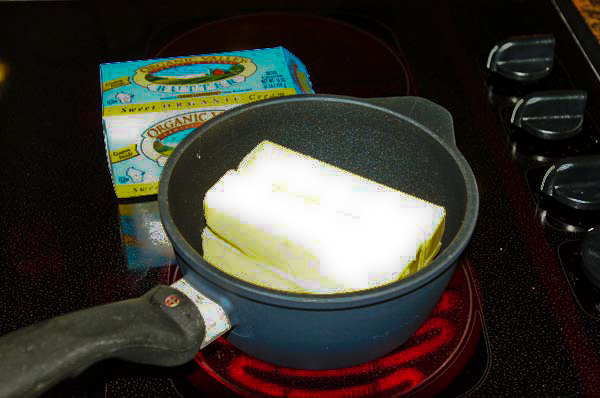 Melt the butter in a saucepan over medium heat and then allow it to just simmer very lightly for about 5 minutes. Stir while the butter melts to break up the proteinaceous clumps. Simmering lightly will ultra-pasteurize the butter and will thoroughly liquefy the butter and allow the water and white protein components to sink to the bottom, the fluffy protein layer to float to the top and the butter fats to be in the middle.
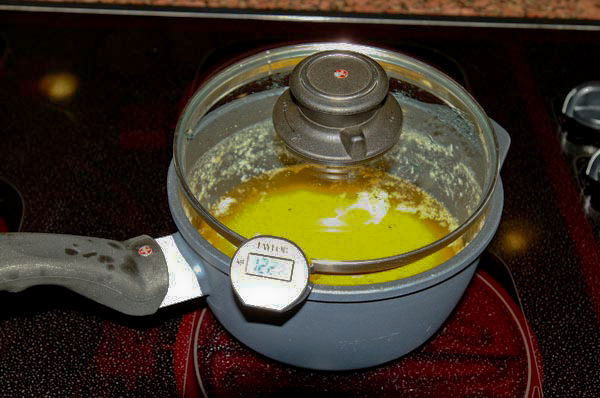 Next, remove the saucepan from the heat and keep covered to keep out airborne bacteria and allow to cool until it reaches about 120 degrees, or is just a little too hot to comfortably hold. It does not matter if water condenses on the saucepan lid while it is cooling.
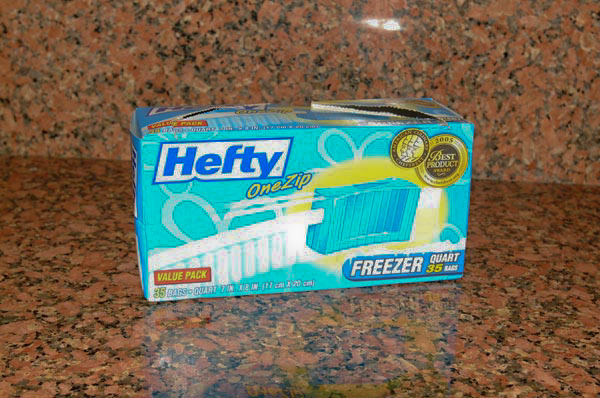 When it reaches this temperature, carefully pour it into the plastic heavy duty freezer storage bag and zip it closed.
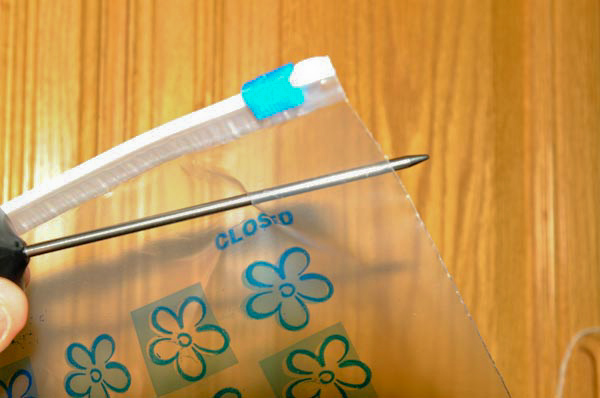 While holding the bag upright, in a top corner of the bag, about 1.5-in from the side and top, punch about a 1/8-in hole through the bag with a pointy object like a carving fork, not a knife.
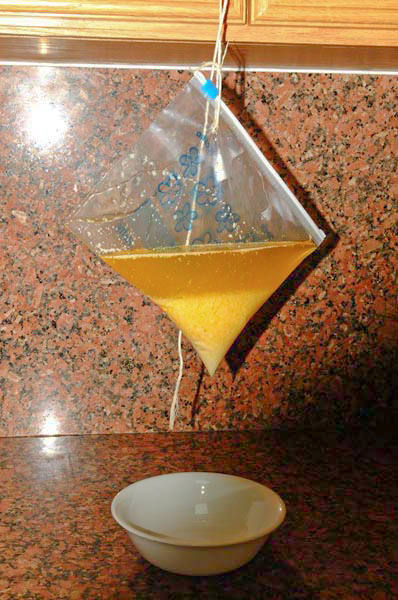 Feed a length of butcher's twine though the hole and tie the string to the bag. Do not use a thin monofilament string that might tend to tear the plastic bag. Take the other end of the string and tie it to the handle of a cabinet door so the lowest corner of the bag hangs about 6-12 inches over your kitchen counter where you will place your collection vessels. (You could forego the string and tying it part, but you would have to have everything else very close at hand and would have to hold the liquid butter for the rest or the procedure - boring and not very appealing. The heavy duty freezer bag and butcher's twine will easily support this.) Allow the bag to hang for 10 minutes.
 You will see the butter separate into three fairly distinct layers as described above. Once the layers are distinct, have the first bowl positioned beneath the lowest corner of the bag. Then use the scissors (not a knife-you need a clean cut) to cut off the corner 1/8-in of the bag and allow the watery component to slowly drain into the bowl. If the flow is too slow, and it is clogging, snip off a tiny bit more. It is ok for the corner tip of the bag to fall in because this is refuse.
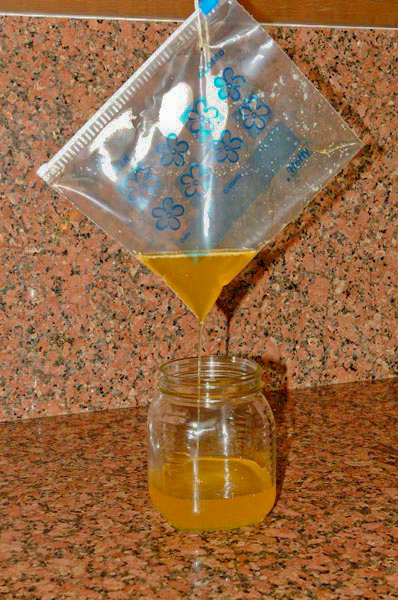 Once the watery part is emptied, have your mason jar ready and just slide the bowl over and place the mason jar under the flow and catch your clarified butter.
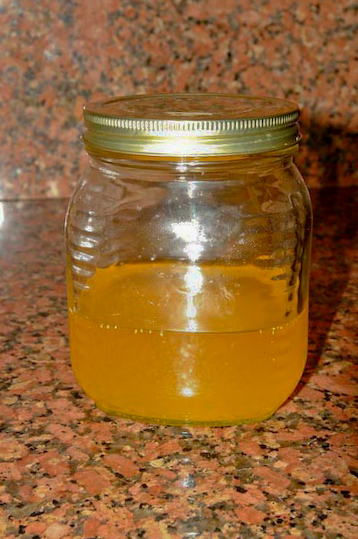 Watch as the golden fatty component drains out, and, when the foamy white top layer is about to drain, slide the first bowl back under to collect the remainder of the fluid in the bag. That's it. You have one bowl of refuse and one mason jar of clarified butter. If you want to make it even purer, you can pour the clarified butter back into a clean pan and repeat, but unless you misjudge the flow as you collect it, this should not be necessary.
If anything goes wrong on your first attempt, just collect the butter, re-heat and do it again.
Additional notes
Start by cutting a small drain hole in the corner of the bag. If the flow is too slow, you can always cut the hole slightly larger.
It may be necessary to light tap the side of the bag as the butter is draining to unstick the material from the sides of the bag.
I have used this method for over twenty years.
GaryProtein is an avid contributor to discussions throughout Cooking For Engineers.
Related Articles

Props for posting reader generated articles!
The salt will be almost exclusively in the water/protein layer, so from a chemistry perspective, it will not make any difference with your end product.
In laboratory separations, I often find it helpful to add NaCl to the aqueous layer to increase polarity; it helps reduce an emulsion at the interface between two layers. By this token, using salted butter should hasten the separating process.
I'm glad you liked the technique, but DON'T use a laboratory sep funnel unless you have a large one with a large hole in the stopcock. That was my first attempt over 20 years ago, and it didn't work because my sep funnel had too small a hole for the proteinacious matter to pass through-it just clogged up. I would also add, the sep funnel was VERY difficult and time consuming to clean. Just use the plastic bag. I've been there!
Subject: Unsalted vs Salted Butter
Most recipes I see on the internet say to use unsalted butter. Is there any reason to use salted butter?
Occasus;
The reason for using unsalted butter in most recipes is because one doesn't know how much salt the butter contains. By using unsalted butter one can control the amount of salt in the dish. Originally salt was added to butter as a preservative not as a flavoring agent.
Someone once said, "All ghee is a type of clarified butter, but not all clarified butter is ghee."
Clarified butter is solid, even if just allowed to cool to room temperature, and is a little harder than regular butter at the same temperature. This is especially noticeable from the refrigerator.
Cheers.
http://www.ulteriorepicure.wordpress.com
Calrified butter is used because regular butter burns when heated.
If you can hold the food in your hand (or mouth) that you are placing in the bags, there is no problem.
DON'T use a real sep funnel. I've been there and they are very hard to clean, and they clog at the stopcock. It isn't worth the appearance of finesse they can demonstrate when it comes time to clean them.
A little perchloric acid (70%) will take care of that problem. :shock:
Old Chem Major
A little perchloric acid (70%) will take care of that problem. :shock:
Old Chem Major
Let me know when perchloric acid becomes a standard ktichen item. :lol: I'll concede, you never know what a person who owns a separatory funnel and ring stand may also have in their house!
How many engineers does it take to screw in a lightbulb? Depends -- where are we building the bulb plant? :)
Some things of note:
If you make one stick in a small stainless steel sauce pan, then let it cool to perhaps about 100 degrees, nearly all of the milk solids will stick to the bottom of the pan. I can only think of a handful of recipes that require more clarification. Simply pour it off. This will *not* work for non-stick teflon pans well. For a bit more refinement, use a standard fine mesh stainless skimmer or sieve when you our it off. Easy to clean. This works for larger amounts in bigger pans as well. Think about 1/4 to 5/8" deep when melted. No wasted plastic bag, string, nor hassle.
Another good tip: Get a silicone ice cube trays that have cavities measured in Tbsp and Tsps. Pour your warm clarified goodness into these and cover with plastic wrap (mostly to keep from spilling). Transfer to freezer. Once hard, put into freezer bag and store nearly indefinitely if you keep moisture out. This makes it easy to use as often you don't need very much and taking it out of the fridge, heating it up, measuring what you need, then returning it shortens the life of the product and is a time waster.
You can also "wash" clarified butter like you would lard to clean it up, but I think the method is kind of messy and wasteful unless you are making bunches of it. I have seen seafood restaurant kitchen staff do this, but they are working with gallons of the stuff.
Richard
Many thanks...
-since salt is a preservative, unsalted butter needs to be a higher grade to start with. So you are buying a better product.
-easier to manage the saltiness if you add it yourself.
-it "cooks better" whatever THAT means.
-"it's better because I say it's better." (I didn't argue)
I have made clarified butter for years, but never came up with this bag trick- ah, the benefits of sharing knowledge.
I make it for our fishing trips in Canada- no worries about spoilage, and nothing, well, almost nothing tastes better than just-caught walleye fried in butter!
The solids etc. are saved, and used on sweet corn, baked potatoes, and anything else that cries out for butter.
1.Take Unsalted Butter and put it in a heavy-bottomed pan on medium heat.
2. Allow it to melt and come to a boil.
3. Once it starts boiling, reduce the flame to a low and allow it to froth/foam.
4. Keep stirring to make sure it does not burn at the bottom.
5. Once there is a golden brown layer at the bottom, turn off the flame.
6. Tip: take a tablespoon of water and pour it into the pan on the ghee. It will bubble and all the foam will dissapear.
7. Allow it to cool down.
8. Sieve it into a clean, dry jar or container.
9. Allow it to come down to room-temperature and store.
Tips:
1. Make Ghee in bulk and pour into small containers. Keep one in use out and rest in the refrigerator for longer shelf-life.
yum!
Seems like that would do for separating clarified butter, too.
Also, using the milk solids on popcorn? Yes! I've never understood why recipes always say to discard them. They are so flavorful! I mix them in sauces, like tomato sauce*, and add them on garlic bread for an extra hit of butter flavor.
*Yes, tomato sauce. I discovered, purely by accident or serendipity or instinct, when I was in my teens that adding a pat of butter to my plate of spaghetti softened the acid edge of the tomato sauce while leaving all the tomato flavor.
So, you (chemical) engineers, why does this work?
Someone conjectured to me once that the calcium in the butter binds with the acid. However it works, it lets someone like me, who breaks out in a rash from too much acid food, eat tomato sauce without dermal disasters.
Thanks again for great info and ideas.
At low heat, melt butter in a pan that's a few inches higher than the melted butter.
Continue heating at low heat until it starts to bubble, just a bit. Keep the heat pretty low so it stays at that slow bubble. Gently stir from time to time to encourage some of the water in the foam to evaporate off.
If you're making ghee, heat until the solids on the bottom begin to turn a golden brown. If just clarified butter, just until you think you've driven off enough moisture.
With a fine-mesh skimmer, pull off the floating solids that remain. Discard those solids, or use them as you wish.
Set up a jelly strainer over the container that will hold your clarified butter/Ghee, then gently pour the melted butter through the jelly strainer cloth. You will end up with nearly perfectly clarified butterfat, and very little loss. If you try to strain it without first skimming, the jelly-cloth will blind and it will take hours to filter.