I suppose I'm obliged to talk briefly about how butter isn't actually bad for you and how natural saturated fats can actually be beneficial to your body and, maybe, even necessary for good health. I'll try to keep it short: In an earlier article on the topic of Saturated Fats, Cholesterol, and Heart Disease, I wrote about the misinformation concerning saturated fats (the family of fats that butter belongs to) and questioned the link between cholesterol and heart disease. Scientific studies that make a distinction between natural fats and processed fats show that previous evidence that linked fat consuming with obesity and heart disease may not be as straightforward as the commonly believed notion that fat consumption increases weight gain and the risk of heart disease. More and more often, as studies are being conducted more accurately (by not lumping processed fats with natural fats in the same category of study), it is being shown that there is either no correlation between natural fat consumption and obesity and in some cases an argument can be made that the consumption of natural fats can actually promote weight loss! Cholesterol has been "feared" in the last thirty years because it is suspected to be an indicator of heart disease. However, as study after study shows that blood serum levels of cholesterol are less accurate at indicating risk than a meteorologist is at predicting weather two weeks in advance. In fact, cholesterol is a fundamental building block of the human body necessary for proper operation of our brains, maintains a healthy digestive system, is a fundamental building block for many hormones, and serves as the body's main healing agent. It is in this capacity (as a healing agent) that has perhaps caused the most confusion in the understanding of how cholesterol works in the human body. When large amounts of cholesterol are found in the brain of someone afflicted with Alzheimer's disease or who has suffered a stroke, is the cholesterol the cause of the problem or is it there because the body is trying to fix a problem? Many researchers are beginning to believe that what is readily accepted in the medical community (that cholesterol contributes to heart disease, strokes, Alzheimer's, etc.) may in fact be a misinterpretation of the facts. Cholesterol is often found in the plaque that forms on the interior lining of arteries, but more and more researchers believe that the cholesterol is being used by the body to fix damage caused by other substances (such as polyunsaturated fats that have broken down releasing free radicals). Additional research has recently shown that the consumption of cholesterol helps to regulate blood serum cholesterol levels as well. Not only does feeding dietary cholesterol to individuals with low serum level increase their cholesterol, but feeding dietary cholesterol to those who have high cholesterol levels actually brings the level down. High serum level of cholesterol are typically caused by the body's overproduction of cholesterol and the dietary intake of cholesterol provides triggers to the body to reduce the excess production. It should also be noted that dietary cholesterol accounts for less than 1% of the cholesterol circulating in the blood and is less than 0.2% of the total body pool of cholesterol in the average person.
Related Articles
Making butter is simple and easy (with modern appliances). You can churn the butter from cream in a blender, food processor, mixer, or even some bread machines. All you need is a machine or device that will agitate the cream so that the fat globules in the cream are destabilized. This causes the fat globules to start to clump. This clumping first enables tiny air bubbles to be trapped in the cream forming a relatively stable foam that we know of as whipped cream. When the agitation continues, the fat globules begin to clump so much that the air and fluid being help in place cannot be contained any longer. The foam seizes and the fat network begins to break down into large fat clusters that we call butter. In this example, I'll use a standing mixer to produce almost a pound of butter.
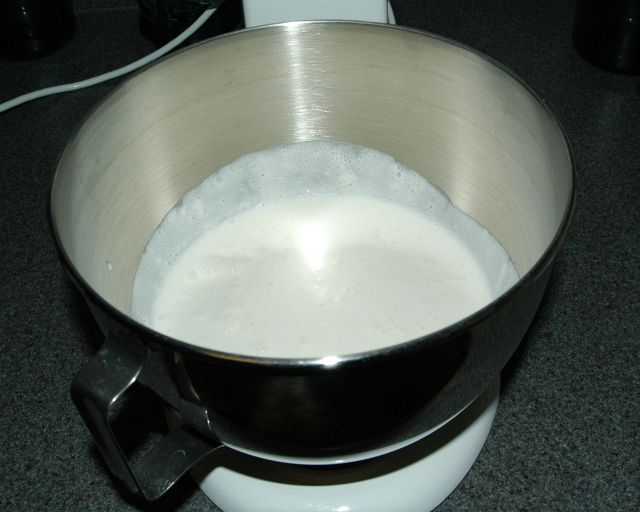 Start by pouring heavy cream into the bowl of a standing mixer. In this example, I started with a quart of heavy whipping cream. Traditionally, butter is made from soured cream. The milk is allowed to sit for a long time (perhaps a week) and the cream is skimmed off regularly to build up enough cream for churning. During this process, acids are formed as the cream sours. These acids help to break down the fat globules during churning so that they can stick to each other - thus aiding the creation of butter. The acids also provide a flavor to the butter that we no longer enjoy with manufactured butter. Since we are using an electric appliance to churn the butter for us, it's not necessary to sour the cream prior to butter making. However, for stronger flavor, you can add a tablespoon (15 mL) of store bought cultured buttermilk to each cup (235 mL) of cream used. Let sit for about 12 hours at room temperature before beginning the butter making process.
 Start the mixer with the whisk attachment on low speed (to avoid splatter) and progress to medium speed as the liquid begins to thicken. At this stage, the cream drips in long thick strings.
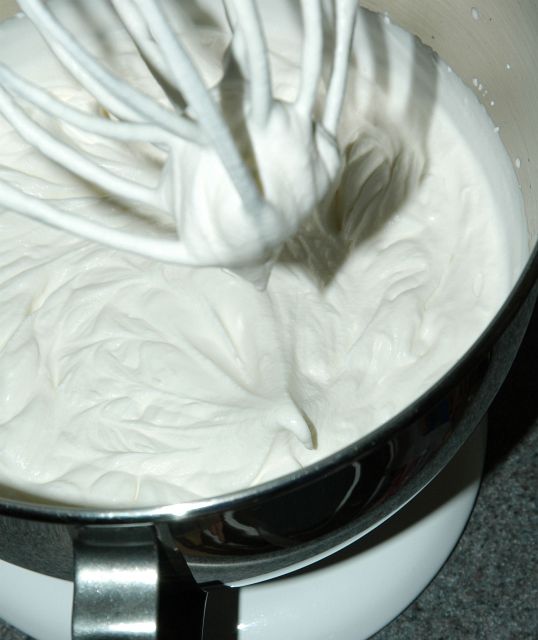 Increase the speed to medium-high or high (if the cream allows that without splattering). Just a short while longer will bring the whipped cream to what is known as soft peaks. At this point, dipping and withdrawing a whisk or other implement (such as your finger) from the cream will form a sharp rise in the cream that has a drooping tip. This is referred to as forming soft peaks. Whipped cream in this stage is often used for baked goods and usually involves folding the cream into another mixture.
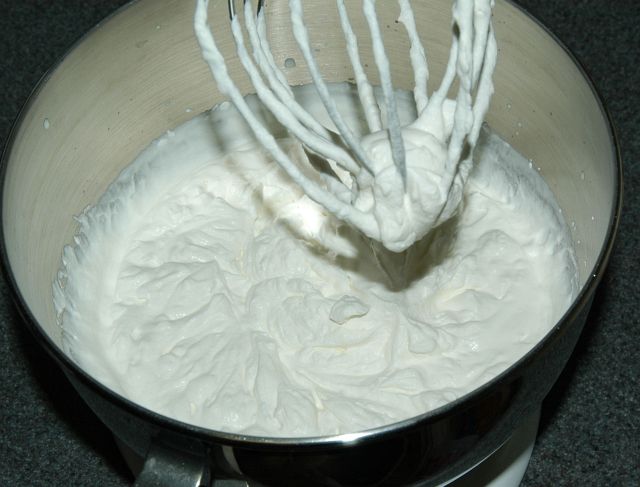 The next stage that the cream enters happens very quickly. The cream begins to form stiff peaks (when an implement is dipped and withdrawn, the peaks that are forms stand up straight without drooping). This is typically the target stage for whipping whipped cream. Whipped cream that forms stiff peaks is often used as a topping for fruit, pies, beverages, and anything else you can think of. (Try adding a little horseradish and serving with prime rib). This picture shows the cream just past when stiff peaks begin to form. To avoid overwhisking, it's often a good idea to whip the cream to soft peaks and then take it to stiff peaks with a hand whisk.
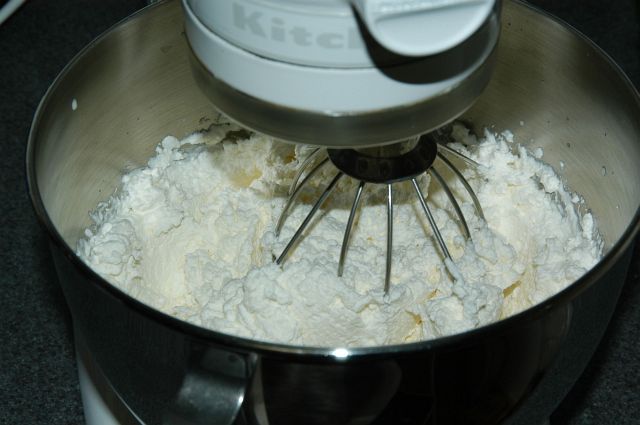 Next up, is a stage for which I do not know the name (or even if there is one). It's just past stiff peaks where the cream just begins to crinkle up. This is when the cream is about to seize and become butter. The color of the cream also takes on a very pale yellow color. This stage is a favorite of mine for topping cakes and cupcakes. I like how it's not as airy as regular whipped cream and has a rich, full flavor. You can "save" the cream from entering the butter stage by adding more cream and whisking it back into stiff peaks. It won't be quite the same as if you stopped at stiff peaks, but it should suffice.
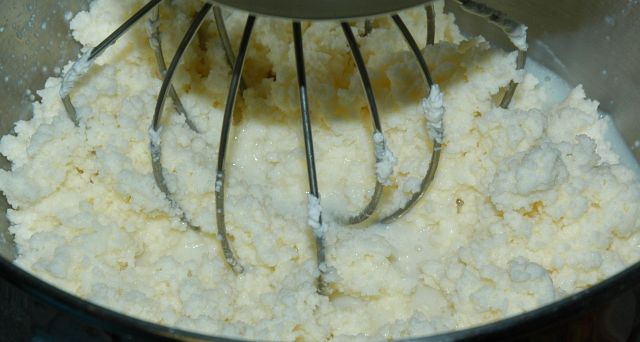 A few seconds later, the mixer should churn the cream into butter. This happens quickly and rapidly - the cream suddenly seizes and buttermilk floods out while pellets of yellow butter form. You'll want to slow down your mixer at this point to prevent slashing the buttermilk all over your kitchen.
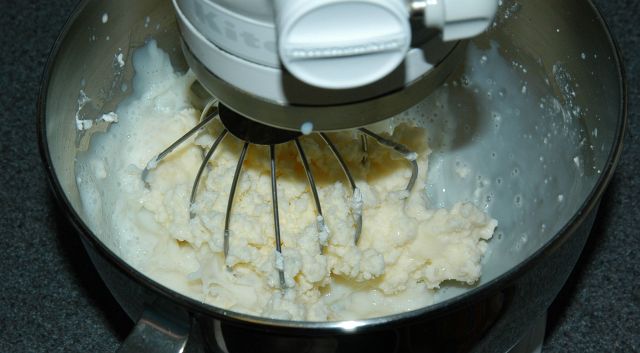 The amount of liquid that is expelled as the butter begins to mash together into a larger lump is considerable. At this point, it's best to remove the buttermilk (you can reserve it for use in baking recipes - use as if it was whole milk, not buttermilk) and keep mixing a bit longer. The buttermilk is only about as acidic as regular milk because we did not sour the cream before churning. You can approximate store bought buttermilk (which is actually cultured buttermilk) by adding a little lemon juice, but it won't be quite the same. Also, our butter milk has a bit more fat than the 1% fat cultured buttermilk sold in the supermarket.
The butter should be washed to remove as much of the butter milk as possible. This can be done by placing the butter in a bowl with cold water and kneading the butter. When the water discolors, pour it out and more cold water. Not washing the butter will result in butter that my go rancid because of the buttermilk.
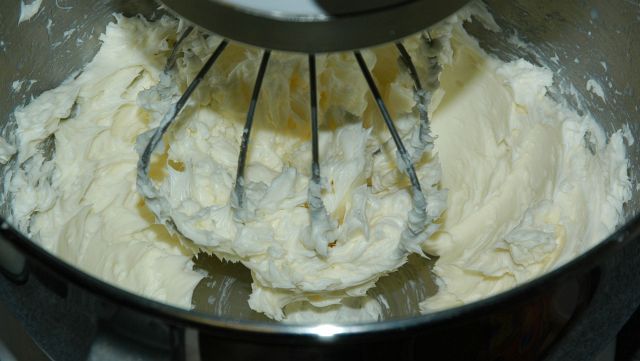 At this point, the butter can be wrapped and frozen or refrigerated for storage. But why not keep working it a little? Continuing to whisk the butter at high speed will start to beat in some air making the butter a little lighter and smoother.
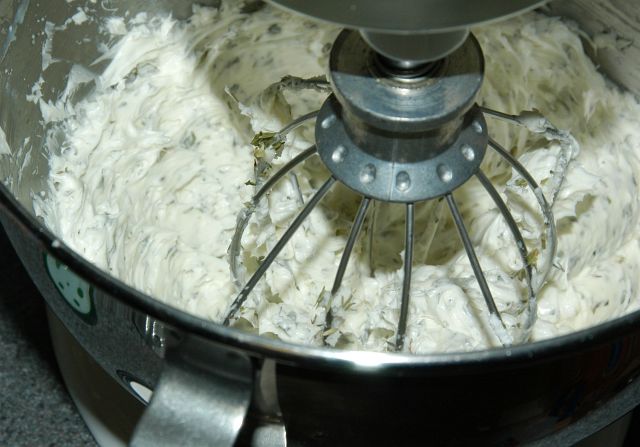 Additional ingredients can be added to make new kinds of butter. Salted butter can be made by whipping 1/4 teaspoon table salt to every 4 ounces (115 g) of butter. Other popular additions are herbs and garlic. Use about 1 clove of garlic, finely minced, for every 4 ounces of butter (or more if you like garlic). For herbed butter, I use about 2 Tbs. of dried herbs for every 4 ounces of butter. In this example, I used an even mixture of dried basil, parsley, tarragon, and crushed rosemary.
 Once you're done whipping your butter, measure out reasonable portions (I like going with the U.S. standard of 4 ounces per stick) onto separate pieces of wax paper or plastic wrap. Roll the butter into cylinders and twist and close the ends. Slip them into the freezer or refrigerator for future use.
Of the 32 ounces of heavy cream I started with, I ended up with 14 ounces of buttermilk and 14 ounces of butter. I assume the other four ounces were buttermilk rinsed away during the washing phase.
Related Articles

With enough sugar in the child, this is very effective and takes just a couple of minutes. Keeps them busy too.
Quick question, is heavy cream the same as double cream?
Whole milk - 3.6% (depending on breed and diet)
Half-and-half - 10-15%
Single cream - 18%
Light whipping cream - 30%
Heavy whipping cream - 36%
Double cream - 42% (some countries as high as 50%)
In any case, double cream has a lot more fat, and so will be easier to churn into butter (and really easy to overwhip when making whipped cream).
I also agree with you about the butter, I would much rather have a bit of yummy butter, than heaps of horrible margarine (yuck)
Fats is a pretty complicated topic, but I think that's a great idea. I have a table of smoke points already, but I think I can focus on a variety of popular cooking fats and their nutrition, affect on the body, etc. It has now been added to my to-do list.
Micheal,
In regard to the "heavy cream" I can only find half and half, coffee, and whipping cream designations in the stores? Is heavy cream whipping cream? (30%MF) ?
Also for a future article....
I often wondered the differences between olive oil, light, extra light, virgin, extra virgin designations.... could you please shed some light on when to use which kinds, or if there is "quality" differences between them? Someone told me use only extra virgin as a salad dressing but cook (heat) only regular or light? Any background, scientific or otherwise would be appreciated!
GREAT site! keep up the good work!
Martin.
Great shots of the mixer!
No sarcasm, really...what digital camera do you use to get such great exposure and resolution?
I don't think we'll be making butter soon, but we have recently started making a mayo for potato salad. It's a big hit, except with the Hobart mixer operators.
Thanks for a serious yet fun website on cooking -- the scientific way.
Except.. How do I find a cream wholesaler?
Like, what would I look up in the yellow pages to find something like this? I'm just drooling over the idea of buying a half gallon of cream, but no idea where to look. On that note. Anyone know of a good place to get ridiculously large containers of cream or mascarpone in the Berkeley, CA area? Thanks!
Ah, exactly what I was wondering myself.
-Elizabeth
I learnt to make butter from my grandmother and mom. We would skim the cream off of milk and from the yoghurt we made. I guess the little bit of yoghurt that creeps in to the cream helped give the butter some flavor (like the soured cream you mention).
While I won't deny that there's a certain satisfaction that comes from making things from as scratch as possible, can other people taste a difference?
www.UdoErasmus.com
Teresa
My father who owned a tiny dairy was resourceful. He collected the cream and made butter. How? He sterilized our wringer washer ( very old laundry technology) with several bleach washes and boiling water rinses. He poured gallons of cream into the sanitized washtub. He turned on the washer and the centrifuge churned the cream into pounds of yellow butter. We stashed the pounds into the freezer and had fresh butter for three years!
My guess is that the marble helps agitate the cream while you shake it. It might reduce your shaking time - or it might not make a noticable difference (or a bad shake may break the mason jar...)
I managed to find real cream at the farmer's market, and it doesn't have any additives, works well, cultures well, and I can get an entire quart for the same price I was paying for a pint of grocery store "cream."
Pasteurization makes some difference in flavor if you're going to culture the butter--raw milk has a slightly different blend of bacteria than an add-your-own culture. UHT milk, as noted above, often won't culture at all. You can buy culture starter at a healthfood store, or you can use PLAIN live-culture yogurt to start the culture (Stonyfield Farm whole-milk is the best commercial yogurt, and it even comes with a nice thick layer of cultured cream on top--yummy).
Lurpak is a very good, although expensive, salted butter (it's in a silver foil wrapper and is usually found with the specialty cheeses). Kerrygold is also good, and expensive. Horizon Organic makes a decent butter (supposedly they also have a cultured butter, but I haven't seen it yet). If you can track down a local farmer who makes butter, it is usually superior to anything in the store.
I believe only one person stated that ultra-homogenized cream would not form butter. I don't know if this is true, but just check the ingredients list on your container of heavy cream to see if it contains anything besides cream. If it does, you probably don't want to be making butter with it any.
The other individuals who mentioned ultra-pasteurized were talking about cultering the cream (growing bacteria) prior to making butter for better flavor. You'll have a tough time doing that with ultra-pasteurized cream unless you introduce your own bacteria colony. However ultra-pasteurized does come together to form butter without any problems.
thanks!
The marble was more of an auditory clue that butter was forming, as I recall. Shake until you can't hear it rattle, and you've got butter.
thank you very much
heyam
my email:
heyam_1974@yahoo.com
Ive always thought the things healthiest for you will go bad quickly, and those that stay aren't so nutritious. I like your statement that butter is not bad for you, another option you didn't mention is mixing some other oil with the butter to increase other variations of fatty acids but yet have the butter taste and texture. Some examples I have tried are Grapeseed oil, Olive oil and Rice bran oil, each of these I have added without changing the taste of the butter dramatically.
smilesalot@mindspring.com
In my opinion, making butter from milk is too long of a process to be worth it. You'll need to let the cream rise, skim it, and let the collected cream sit for about a day. Drain the liquid and whip it for a bit (thirty minutes or more) and let sit. Drain and repeat until the cream starts to clump up and form butter.
I just bought a carton of 500ml 35% whipping creme, regular stuff, put it in a bowl, turned on my mixer, followed these instructions, and wow I now have fresh yummy butter!
I won't buy butter again. Reason? For some reason here in Montreal whipped butter is almost impossible to find. I love whipped butter. This stuff is great. I did find that it did not turn yellowish at all, but other than that, no difference. Good description and instructions!
Start with 1 quart heavy cream. Shake it gently--more rocking than shaking--until it stops sloshing at all. This will take some time but it's easy. I did it off and on, over a period of a couple of hours, in a house at 78 degrees (warmer than some procedures recommend).
Open the cap on the side of the carton and pour out about 1/3 of the cream (you'll put it back later). This is just to get air space. It should be a smooth thick liquid, almost pudding. Now, close the carton and shake vigorously. In just a minute or two, the creamy liquid will start to stiffen up, rather abruptly. Give it just a few more really hard shakes, and in seconds, it starts to separate; it'll go from sloshing to muddy to almost a crackling sound as the buttermilk frees up.
Shake it a few more seconds to get all the butter out of the buttermilk. Then open the carton, pour out the buttermilk, and pour the rest of the cream back in. Repeat the vigorous shaking, and pour out the second batch of buttermilk.
Now you can pour in water, shake vigorously, and pour it out again, a few times, to rinse the butter. When you're done, just cut open the carton and scrape out the butter. It made close to two cups.
Chris
Anyways, I added the celery salt. Now I have funky tasting cream (It never really turned into decent whipping cream, either. sigh...). So I experimented with a little bit of it in a quart jar in the microwave, just to see what it would do. At three minutes on high the stuff boiled off a LOT of water content, or milk, or whatever. It reduced to about a third of it's size, and I saw yellow globs in there. Hmmm... curious. I put it all in the fridge for the night because I was pooped.
So the next morning there are still a few globs in the microwaved concoction, but they are now white again. Go figure. I abandoned that batch. The funky tasting celery salt concoction is still in a bowl in the fridge.
So I'm in here in my bedroom shaking this mason jar full of plain ole whipping cream, thinking that it's not going to work because I'm reading about all the difficulties of ultra-pasteurized or stuff with those extra chemicals in it, and I'm thinking, ok, it's about time to stuff this stuff in the fridge and hit the hay. I open the jar for about the fourth time, thinking I'm going to have some bubbles in my whipping cream, and I find that.... I have about a cup amount of butter floating in my cream! I had this quart mason jar about 3/4 full and it took me about an hour of constant shaking, but here it is.
So I stuck with the jar thing because I seem to remember that's how my Grama did it when they worked at the dairy. She used to skim the cream off the gallon of milk they dipped out of the milk tank (straight from the cow) and brought home. Then she filled up 4 or 5 mason jars and all of us, grownups and kids alike, would shake a jar of the stuff while we were watching a movie together. Then Grama had baked bread too (I can still remember it's drop dead delicious flavor, too- gotta love Grama's Southern fat filled cookin') and we had some on some warm bread.
So now I know how to make soap and butter. The sky's the limit!
If anybody knows of any places where I can buy milk straight from the dairy or cow before it gets stuffed full of crap, uh, I mean... chemicals, and boiled to death, I would much appreciate an email: notasnowballs_chanceinhell@yahoo.com
Oh yea: Nutritional info on the thing I was shaking around:
Brand name: Darigold ultra-pasteurized whipping cream, one quart
Serving size for nutritional facts: one tablespoon or 15 ml
Fat calories are 40
Total fat is 4.5 g
Saturated fat is 3 grams or 7 %
Trans Fat is 0 g or 0%
Hope that helps, and please drop me an email, I plan on making more butter because I heard from my diet friends that now the health folks are saying that instead of margarine being good for you and butter is bad, now they have switched and said that margaraine is REALLY bad for you (cholesterol, heart disease, etc.) and that butter has "good" fats, that you need. I wish those idiots up there running things would make up their minds. Personally, I think God gave us what we need to survive in this world, and man is really good at screwing it up. I think I will try to stick to food that is natural as possible and to heck with the FDA or whoever makes those rules. According to all the experts, I'm gonna' die anyways. LOL
I was just wondering if I wanted to make a medium size jar at home with my daughter for fun. How much heavy cream or double cream I should use and if i wanted to sweeten it up a bit with some sugar (so my daughter will eat it) how much sugar should i use. I dont have any type of food processor or mixer except a blender and a electric hand mixer so I was going to take the plastic jar approach with a marble or something for an agitator. Unless i could use a blender or something lol. If someone could help me out I would appreciate it thanks.
Amber H.
I made the butter with a whisk and a mixing bowl.
it took me a good 25 or so minutes of constant mixing... and my arm is sore now (great workout for my arm, really)... but it turned out just fine!
and i used just normal store-bought carton of cream... "UHT pasteurized" works! =)
the hardest part is waiting for the cream to thicken to even just the "soft peak" stage... it took a good 18-20 minutes just for it took thicken up to soft peaks... but after that, the other stages come pretty quick...
so don't give up! it just takes a while! and it sure does help the process if you're watching tv while whisking!
the butter is yummy and fresh... it's just got a different feel to it compared to store-bought butter... i'll definitely be making it again in the future!
BTW I'd love to know exactly what is going on there. How does one emulsion (fat in water = milk) turn into another emulsion (water in fat = butter), just by beating it?
take one litre of milk (2% and above), bring to a boil and cool until lukewarm. Add a generous tsp of greek yogurt (live cultures). With a whisk, mix it well into the milk. Keep the milk covered in a warm place, like a cabinet or inside your oven, undisturbed. You will get fresh homemade yogurt in 7-8 hrs depending on the weather. While using it, remember to save the last few spoons to use to make your next batch of yogurt.
If you make this with whole milk, you will get a whole thick layer of creamy yogurt on the top. Scoop it out each time and collect in a bottle in the refrigerator. Once bottle is half full, you can add some warm water to it and manually shake the bottle for 10-15 minutes to get your own homemade butter.
Hope that helps the guests who've asked about making yogurt above!
You can go us all better and make Cornish-style clotted cream.
1 - Visit a local, preferably organic, farmers market and ask around to find out if anybody knows of a dairy selling raw milk.
2. - Do a google search for a local organic farmers organization that could help.
3. Check out the Weston Price website for plenty of info: http://www.realmilk.com/where.html
I've been buying raw whole milk - cream on top - and eggs directly for several months now. Thanks for the great website - I'll be making butter soon!
When you whip cream, you put everything into the freezer to help the fats solidify and give a nice solid whip. However, if you heat the bowl by running hot water in it first, the whipping cream seems to bypass that whole "whipped cream" stage. Needless to say, it was while making whipped cream that I found this out....but have done that many times since for butter making. It doesn't seem to harm the final product in any way.
I just attempted to make my first batch of cultured butter with organic low pasteurized cream. Everything was going along swimmingly. Cream thickened nicely overnight, beat up to soft then stiff peaks, separated a bit. But, I thought it didn't look like enough buttermilk came off, so I kept on mixing, apparently blending both back together. No matter how much I whipped, I couldn't get the butter to come out again.
Next time I'll quit at the first sight of buttermilk, and I already threw out the cream, but I'm really curious as to if there is anything to do at that stage to save the process?
Additionally, all of the cultured milk products in the US must be pasteurized prior to being cultured. So we kill of the naturally occuring bacteria before we add nice,new, FDA approved ones. This applies to organics (Horizon, Stonyfield Farm) too.
I have used it (solely for drinking because it's so expensive) as I could afford it over the past six years with no problems.
I just noticed yesterday that there was a pint of raw whipping grade CREAM for sale at Whole Foods, with the prohibitively expensive price tag of over $11. I didn't check the butterfat content as it wasn't on my shopping list, but now I'm curious.
So after reading all of this about the butter, I just may have to give it a go. ;)
As for the raw milk in Michigan . . . . as well as other states . . . . you can buy part of a cow (cowshare) and then drink the milk from your part of the cow. Most states have a loophole to where you can get raw milk. Some states say it is only legal for animals to drink raw milk, so you buy it for your 'animals'. Raw milk is excellent for ALL people. Especially the immunocompromised, young & elderly!! Esp. since most of our diseases & immune problems come from not having the proper bacteria in our gut. Raw milk helps balance your gut & your mouth for a better, cleaner smile too! :) visit http://www.realmilk.com/ for great insight to this lost information!
It's pretty sad they have a law against drinking something healthy, whereas it's perfectly fine to fill our foods with known TOXIC chemicals! Go figure!! :shock:
we have been bombarded by the FDA & media that raw foods are dangerous to our health. :angry: UNTRUE! We are more sick now because of all the 'processing' man has done to our foods because of fear of germs. Now we have super viruses because of that interferance. I really believe it's not the viruses that have gotten stronger, it's that our bodies have become so weak that we fall prey to every type of bacteria & germ out there! Our bodies don't know how to respond to any kind of invader.
ok, off my soapbox!!! ;) Love the site so far: right-on information! Great forum too!
thanks!
trudi@madebytrudi.com
Thanks for posting this!
This is a tricky question.
The short answer is: No.
The complete answer is: It depends!
YES #1: Cookies do not really [need] salt, so even unsalted butter may be used, AND/OR no added salt.
HOWEVER #1: Most people would find that cookies (and most other foods) taste better with some salt added to the recipe, either in the butter or in the teaspoon. Your cookies may seem bland without the recommended amount of added salt.
YES #2: If you are trying to reduce sodium in your diet, you may certainly eliminate or reduce the amount of salt specified in the recipe.
HOWEVER #2: The amount of salt added in baking recipes is fairly insignificant if a person consumes a reasonable number of cookies at a time. Keep in mind that for any salt-reduced diet plan that salt is found in almost all prepared foods; just be aware of where your salt "allowance" is coming from.
NO #1: Salted butter may be used in any recipe for cookies or cakes, etc. which call simply for "butter". The "salt that it calls for" should be used in the recipe. While some people will insist that only unsalted butter should be used in baking, using unsalted butter in a recipe which includes adding salt serves no purpose. It is a myth that only unsalted butter should be used for baking.
However #3: Recipes which call for unsalted butter have validity when the salt content must be precisely controlled or eliminated, usually having to do with the chemical properties of salt. This does not generally include cookies . . .
NO #2: Recipes using cultured (unsalted) butter should use the appropriate ingredients to achieve the intended result.
HOWEVER #4: Recipes are instructions to reproduce exactly a product that someone has decided is worthwhile reproducing. Alterations to any recipe are not wrong; they just produce a (usually slightly) different product. The different product may be a disaster or an improvement or something in between, depending on who is judging the difference. For some people, even slight deviations from a very specific standard fall short of a satisfying result. Others may notice no difference at all.
-Victoria
This is exactly what I've been looking for...a cooking site that isn't just a recipe site, but a TEACHING site as well.
I've always been very inquisitive, so learning is a big part of my mental happiness.., and Michael, you've taught me my first lesson of the day!
Even though I've beaten cream into butter before, I really never knew that I had to "wash" the butter for safety reasons. Thanks for that information!
Great site! Reminds me of an Alton Brown segment on the food channel, which I LOVE! lol.
Thanks for being here! I'll be visiting often! :D
By the way, how much honey goes in for a really GOOD honey butter, without breaking down the butter?
Just tuned in to this site, wonderful.
Can hardly wait to try making butter. If I am starting with raw milk from our Jersey, how long do I wait for the milk to rise? Is it safe to let it sit at room temperature (bacterial concerns)? and for how long ?
some one seemed to experience less success than more, would like to hear the answer on that also.
thankyou for the teaching how to.
Cynthia
As far as I know, only a physical change. The fats in the cream do not alter chemically (as in their chemical formula do not change) but they form weak bonds as they are slammed up against each other and intertwine like a bunch of yarn clumping together into a tangle. Some water (as well as some of the water soluble components of cream) gets stuck in the tangle and the rest puddles outside of the ball of butter. If you melt the butter gently it doesn't alter it chemically either since it simply untangles and flows more freely. When the heat is removed it retangles and slows down to form butter again.
Of course, technically all of this counts as chemical changes since phase changes and precipitating molecules from a suspension are all considered chemical changes, but I think I answered your question as you'd expect.
Thanks for the idea.
We HAVE made butter w/heavy cream, which was delightful/tasty/fascinating, hence the boy's desire to do so again. Being 12, he wants to do it now, of course. Any advice?
sorry, not gonna' happen. you need high fat cream.
Thanks!
If I were to put heavy cream in a tuperware bowl and tell my little 2nd cousins to shake it, how long would it have to sit and what other steps would be used in this process?
Thanks!
You should be able to knead some moisture out of that butter and pour out whatever comes out and then keep repeating to get your butter back.
How long would it have to sit? Or how long would they have to shake it? I don't know the answer to either of those questions - I'm not sure why it would need to sit unless you were doing the step of adding buttermilk to the mixture to provide some more flavor/tang. In that case, just let it sit at room temp. for about twelve hours before having your cousins shake out their excess energy. As to how long it takes before butter forms - that really depends on how vigorous your cousins shake. I'd guess between 15 min. to an hour.
In WWI (& WWII) dairy butter was strictly rationed, the only substitute was oleomargarines. Due to some pretty stupid laws prompted by the dairy industry, you had to color it yourself ...
http://en.wikipedia.org/wiki/Margarine#Margarine_in_the_United_States
I have made plenty of butter from our own cows' milk and goats' milk but not for a while so the timing doesn't stick in my mind (too much stuff crammed in there!) :P
I have made plenty of butter from our own cows' milk and goats' milk but not for a while so the timing doesn't stick in my mind (too much stuff crammed in there!) :P
I meant to say cream instead of milk...of course I let the cream rise to the top of the milk and use that. What is the sense of churning your own butter if you use dead (pasteurized) cream? Healthwise, makes no sense. You can, though, control the quality of your product if you purchase milk from organic or naturally raised animals instead of taking the commercial product of factory-raised animals...poor thangs! If you can't afford organic, at least buy your fats, then meats that are organic as pesticides cling to fats and your brain needs/uses fats, you can probably figure out the rest yourself. In my opinion, what the USDA says is good is probably bad and what they say is bad is likely good. There are exceptions to every rule...!
When I said "find the dates" I meant signs, the moon passes through the signs of the zodiac and they influence the butter making, breadmaking, planting, fishing, etc. For example, today, November 11th of '08 the moon is passing through Aires. The moon is waxing and it will be full in a couple days.
Again, I may not find this site again and will forget about it (the stuffed brain syndrome) so if you want to dialogue with me, myrick@middlebury.edu. Later.
You guys say you're engineers and "analytical". What bullshit. You're all just fucking psycho undereducated idiots who are living in the Middle Ages. I'm fed up with this site and it's promotion of outdated ideas and concepts. The internet really is an idiocracy!
or if it irks you so much, just stop using the internet altogether. it would be terrible for an intelligent, educated person like you to stumble across more drivel like this.
Subject: Re: butter that doesn't churn
You guys say you're engineers and "analytical". What bullshit. You're all just fucking psycho undereducated idiots who are living in the Middle Ages. I'm fed up with this site and it's promotion of outdated ideas and concepts. The internet really is an idiocracy!
1) This a great site, full of helpful food science information and techniques
2) You sound like a delightful person, full of tolerance and warmth
3) Instead of ignoring the silly people, you crap all over the site
When we neared the tent we heard the farmer say and thats the butter forming at the top of the cup so keep shaking.
They were making the butter from gold top milk
Ive not tried making butter myself using gold top but thought I'd pass this info on.
thanks,
Katie
You'll probably need to let that cream sit for a while and then lift the cream that forms from that. Usually cream that comes from the initial sitting/separation of milk is too low in fat to be churned into butter.
Finally, I looked at your website for troubleshooting, and decided to go to bed and let my churned cream sit in a glass mixing bowl (put a plate to cover, but make sure there is some air space) at room temp for 12 hours. Next day, using a electrical hand mixer, I varied the speed from medium to low for about 5 - 10 minutes (there is some minor splashing; remember my cream was semi-churned from the day before so if it was not already churned, it may require longer mixing time with the blender), then it instantly separated into whipped butter and buttermilk. I decided to use both this homemade butter and buttermilk to make my banana bread, and it turned out wonderfully.
For my next attempt at making butter, I hope to be able to skip the churning step. I will also experiment with letting the cream go past the expiration date for possibly better results and flavor because it seems like the longer the cream sits in the refrigerator, you start getting thicker cream on top. Based on this website, I may be able to skip waiting for the cream to get to room temp. When pouring the cream into a large mixing bowl, definitely tear open the carton and collect all the cream that sticks to the walls of the carton which is the primary component for butter you don't want to go to waste.
I am not a big fan of salted butter. I prefer unsalted butter. Once you get accustomed to unsalted butter, you don't want to go back to the adulterated form. The salt overpowers the delicious pure butter flavor. The dairy company wants to get you addicted and habituated to the salted butter because the salt helps the butter store longer. You never want to use salted butter for baking, or cooking for that matter, because it's harder to control your salt content, and can ruin the recipe.
I would say that unless you have access to cheap cream, this is a pretty expensive way to make butter, but it tastes delicious!
I appreciated your comments on cholesterol. Could you elaborate a little further on the good cholesterol and the bad cholesterol that we hear about in the light of your research? Where does it fit into the emerging picture? Thanks.
From what I've deduced from my readings, bad cholesterol is correlated with heart disease (such as atherosclerosis). As LDL levels rise, risk of heart disease and artery blockage increases. LDL is also found in the plaque that forms on the arterial walls in the case of atherosclerosis. However, increased risk does not indicate causation. There are studies that show that some populations with high LDL levels have a reduced incidence of heart disease. Some doctors believe there are other factors (genetic, etc.) and more or less ignore those studies as outliers. I currently believe that cholesterol levels should be used as an indicator - if you normally have low cholesterol levels and it increases, then there may be something causing the increase that should be addressed. The body naturally produces larger amounts of cholesterol when stressed (either physically or mentally) and the removal of these factors could do more to reduce the chance of heart disease (and subsequent reduction in bloodstream cholesterol content).
After making butter from that for awhile, and then using store butter, I noticed that there was still a difference in the outcome. I realized from reading your site that we just weren't whipping it enough (didn't get to the buttermilk part---didn't know that there was even seperation involved!). Thanks for the detailed information, as well as pictures. I might look around your site more, and perhaps invest in a KitchenAide : )
Quick question: what is the chemistry behind the color change when you make butter?
Quick tip: did you know that 1 Tablespoon of sour cream can be substituted for 1 egg in a recipe?
I have been making butter for MONTHS with raw cream. Yes, even the first skimming! I have Jersey/Guernsey mixed cows. I let the cream come to room temperature. I either let my kids shake in a jar or use my stand mixer. I have butter in anywhere from 10 minutes to an hour depending on who is doing what. I have never had a batch fail. I've never had to add lemon juice or any other additive. I do KNOW it needs to be at room temp. and you CAN NOT make butter from milk-- soy milk, evaporated milk or ANY KIND of milk. It needs to be high fat containing cream!
I even put different flavoring in the final product, such as fresh herbs or garlic! YUM! Enjoy!
Keep beating the yellow liquid. The stuff making the liquid look yellow (fat clusters) should start to clump up and form a solid mass.
Thanks, that's roughly what I ended up doing, but the mixture didn't change much except that some fat gathered at the top. I assumed that since I was using a blender, the mixing was going too fast to allow the fat to coagulate. So I decided to just let it sit for a while, and in about 90 minutes, I had a much thicker product. At that point, a little agitation with a spoon separated the buttermilk, which I poured off. After rinsing what was left, I had butter!
Thanks, that's roughly what I ended up doing, but the mixture didn't change much except that some fat gathered at the top. I assumed that since I was using a blender, the mixing was going too fast to allow the fat to coagulate. So I decided to just let it sit for a while, and in about 90 minutes, I had a much thicker product. At that point, a little agitation with a spoon separated the buttermilk, which I poured off. After rinsing what was left, I had butter!
Yeah, this doesn't work in a blender. The blender tends to break the fats up and evenly distribute it through the liquid - setting you back just about as fast it it brings the butter together! Stand mixer seems to be best followed by food processor.
Coffe shops and restaurant will often give you expired or about to expire cream free just for asking. I get 3-4 cases of heavy cream from the coffee shop at the ski resort where i live at the end of every season. It easily makes enough butter for the entire year for my family.
Anything that agitates the cream will work. Raw milk probably won't work unless you let it settle and use the cream portion (and then let that sit and use only the cream from that).
You didn't explain what went wrong... hard to debug without knowing the problem. The only thing I'd suggest at this point is to allow the cream you skimmed off to sit and settle - then skim off the cream that forms there. The first skimming usually doesn't have enough fat to make butter easily. As for the culturing part - I would use a thermometer instead of the bubble/finger technique.
It's portable and easy to use.
Cream separators electric and manual , manual cream separator w/ butter churn attachment, butter churns.
Please visit this site for details:
http://slavicbeauty.ecrater.com/
please email me should you have any questions:
uabookinist@yahoo.com
The cream is already seperated at this point.
When you start the directions start at a slow speed, but skip the peaks, you will butter in a matter of minutes.
My total whipping time is less than 10 minutes. It takes longer to clean up than make butter.
Enjoy and don't be afraid of trying something new. It's just a quart of cream!!!
I've been using small Tupperware containers for everyday molds, and I have a couple of plastic soap/candle molds for when I want the butter to look a bit fancier at the dinner table. I also recently bought some wooden butter molds from the late 1800s or so from an antique store - haven't gotten around to using them just yet.
The butter might not taste significantly better than store-bought, but I like having made it myself. Just like having made my own bread and jam. Even if the final product is similar to what I would've bought, I still have control over what goes into it, how it was made, and the satisfaction of having done it myself. I've learned bunches about physics and chemistry by researching and executing these sorts of projects for myself, which is pretty cool too.
Not too long ago, I tried using my Kitchen-Aid to make butter. I needed a bunch for cooking, and I'd run out of hand-shook butter. Yeah, it made butter in a snap, but after months of shaking it myself by hand, it kinds felt like cheating. I hadn't set any rules for myself, and it's not like anyone else was judging what I was doing, but it was kind of disappointing. In the last week, I've done a ton of baking. I've had to remember to plan ahead and make enough butter for everything I want to bake, and have enough leftover for any other cooking I need to do (like breakfast and dinner!). I'm slowly learning to make more things for myself, and the more I do so, the happier I've become with my cooking - and even my eating.
Your Mileage May Vary.
Thanks!
For my second attempt, I left the cream out for a day and a half, gave it a quick whizz with a hand held blender then put it in a jar and shook, never got too much separated buttermilk which may have reabsorbed a bit, anyway proceeded to washing stage and got plenty of milky water back out, put it in a bowl in the fridge. I then tried adding salt to a small sample but found a lot of liquid coming out of the 'butter' is this wet butter simply solved by continuing to knead and pouring off the excess liquid, I did 'dry' the butter with kitchen tissue?
Should I stop shaking as soon as the thick cream appears in the jar, pour of any buttermilk, shake again and keep getting the buttermilk out? Once washed, shouls I gain keep kneading until as much moisture as possible is out? Thanks
Paul
Making butter was easy, I had a butter churn, but also used a gallon glass jar. Fill the jar about 2/3rd's full and let it warm to room temp. Then in the evening while watching TV we would put the jar on the floor and roll it back and forth with our feet. We had butter in about 10 minutes. Don't try to churn cold cream because it takes too long. we would wash it and salt it, cool it and cut into pieces and wrap in wax paper and freeze. Lasted a long time.
Cheese was another product we made. I had a 5 gallon pot and heated the milk and put in the rennet and ended up with curds and whey. washed the curds and made several kinds of cheese. Fed the whey to the pigs along with the extra milk.
Those pigs loved it. and after they were grown, they make the best pork chops, ham, and bacon.
Those days are gone now. No one knows how to do it anymore.
Thanks for reading my long dissertation.
I agree, it's tasty stuff.
To prepare ghee, butter is melted in a pot over medium heat. The butter begins to melt, forming a white froth on top. It is then simmered stirring occasionally and the froth reduces slowly and the color of the butter changes to pale yellow. Then it is cooked on low heat until it turns golden. The residue settles at the bottom and the ghee, which is now clear, golden,translucent and fragrant, is ready. The ghee is then filtered and it solidifies when completely cool.[1] Ghee has a long shelf-life and needs no refrigeration if kept in an airtight container to prevent oxidation. The texture, color and taste of ghee depends on the source of the milk obtained and the duration of boiling.
oops.
try "clarified butter" or search on ghee
Dec 16, 2006
http://www.cookingforengineers.com/forums/viewtopic.php?t=931
Aug 25, 2005
http://www.cookingforengineers.com/forums/viewtopic.php?t=149
Now I see that no one else put the salt in before it had separated. Did I ruin it with my Finely powdered Himilayan sea salt?
It had separated a little bit earlier but no ball. Did i ruin it by letting it go back together instead of trying to ball up what if had?
I am frustrated.
And feeling like a butter failure.
blenders and food processors may simply be too violent.
I use a KA with a whisk. 2 cups in the bowl, start out medium speed to get a froth, then move to high speed. whips up to 'whipped cream' the 'dry' then it breaks into fat globules and buttermilk.
when the spattering happens, that's the 'butter milk' that has separated from the cream/now butter
suggest you pop it in the refrigerator and let it cool - it should set up. then squeeze out the butter milk.
a blender is not imho an appropriate tool to churn butter. that said,,,,
did you get a separation of butter and a watery liquid (aka buttermlk?)
once the butter fat has lumped up and you have a batch of butter chunks and butter milk, it's time to stop with the whipping/churning/whatever.
the heat from the motor may simply have melted the butter. did it go back to something like butter when it cooled?